Physical Address
304 North Cardinal St.
Dorchester Center, MA 02124
Physical Address
304 North Cardinal St.
Dorchester Center, MA 02124
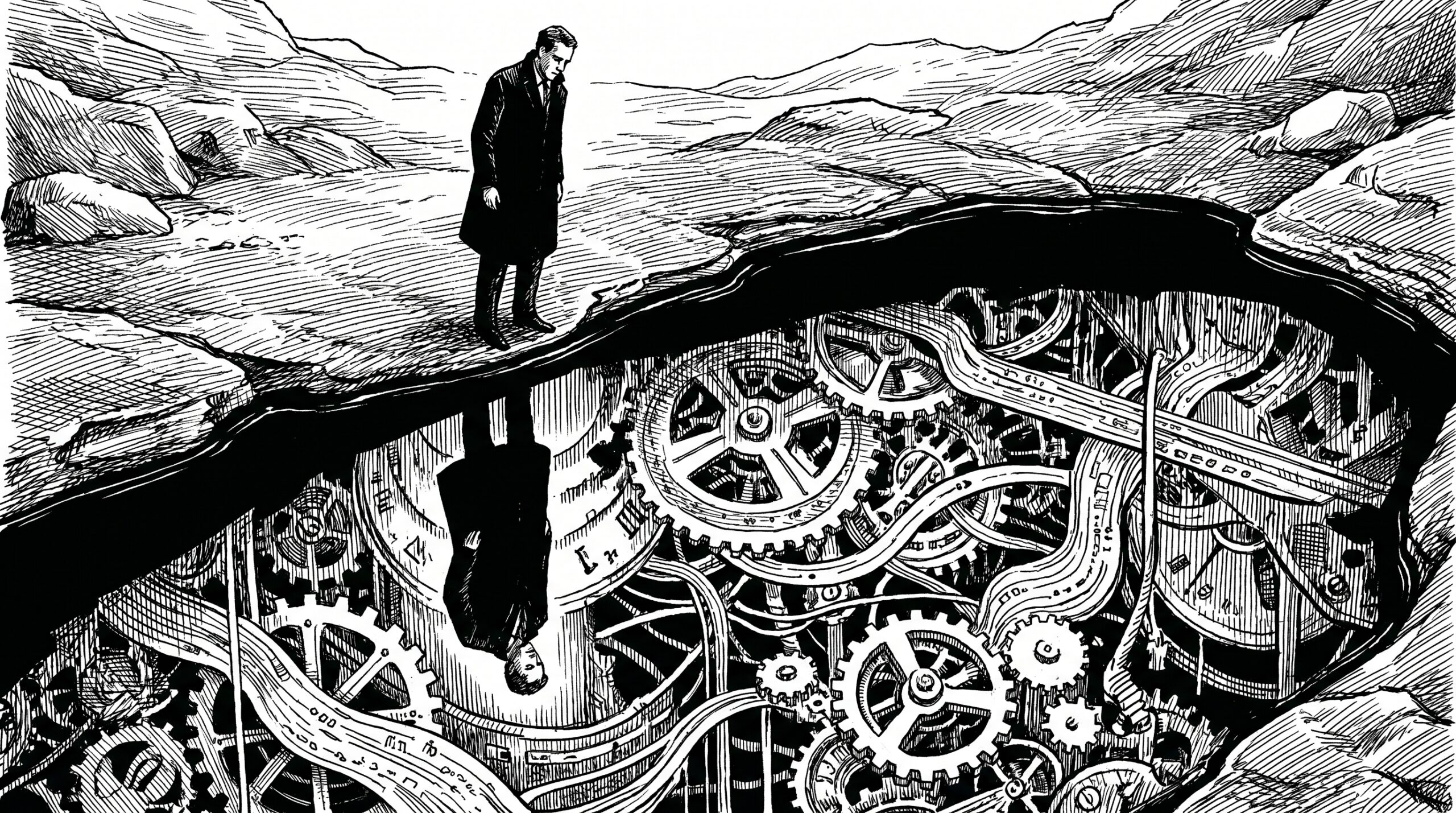
*A deep investigation into why artificial intelligence isn’t the threat most people think it is — and why that’s far more unsettling.*
In 1913, Frederick Winslow Taylor published *The Principles of Scientific Management* — a book that would quietly restructure the entire architecture of human labor for the next century.
His central argument was simple and devastating: the thinking and the doing should be separated. Managers think. Workers execute. Efficiency comes from specialization — from turning human beings into the most reliable, interchangeable components possible within a system designed by someone else.
Taylor’s ideas spread through factories, then offices, then entire industries. We built educational systems around them. We designed careers around them. We learned to measure value by the cleanliness of execution, the reliability of output, the consistency of performance within a defined role.
For a hundred years, this worked. Or at least, it appeared to.
Now, in the space of perhaps five years, we are watching that entire framework dissolve — not because someone decided it should, but because a new technology has arrived that executes better than any human being who was trained only to execute.
The question this raises is not “will AI take my job?” That question, while emotionally resonant, is the wrong frame entirely. The question that actually matters — the one that should be keeping thoughtful people awake — is this:
**What happens to a workforce that was trained for a century to stop thinking?**
—
## The Illusion of Expertise
There is a concept in cognitive psychology called *fluency* — the ease with which information is processed and reproduced. Research by Reber, Wurtz, and colleagues has consistently shown that fluency creates the feeling of understanding, even when genuine understanding is absent.
In plain terms: doing something repeatedly feels like knowing it deeply. But those two things are not the same.
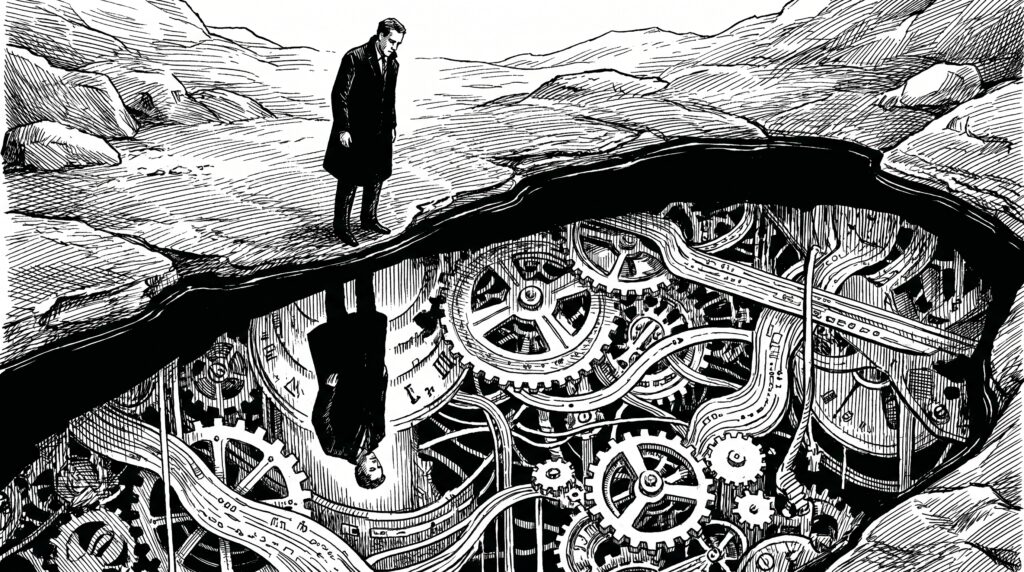
A financial analyst who has built hundreds of DCF models does not necessarily understand capital allocation. A copywriter who has written thousands of product descriptions does not necessarily understand why people buy things. A manager who has run dozens of performance reviews does not necessarily understand what motivates human performance.
What they have is *procedural fluency* — the ability to execute a well-worn process with speed and precision. It feels like expertise. It is rewarded like expertise. For decades, it has been indistinguishable from expertise in most organizational contexts.
AI has made the distinction visible overnight.
When a language model can produce a competent financial analysis, a serviceable product description, or a structured performance review template in seconds, the market suddenly needs to answer a question it has been avoiding for a long time: *what was the human actually contributing that mattered?*
For many roles, the honest answer is: pattern recognition and execution within a defined domain. Which is, precisely, what large language models do better than people.
This is not a criticism. It is an observation about what a century of Taylorist thinking has quietly optimized human labor toward — and why the disruption of that optimization feels so disorienting to so many people simultaneously.
—
## What the Industrial Revolution Actually Teaches Us
History is instructive here, though not in the way the optimists usually deploy it.
The standard argument goes: “Technology always destroys some jobs and creates others. The Industrial Revolution eliminated hand-weavers and created factory workers. The computer eliminated typists and created programmers. AI will eliminate some roles and create new ones we can’t yet imagine.”
This argument is technically true and practically misleading, because it smooths over the one variable that matters most: *the transition period.*
During the industrial transition of the 18th and 19th centuries, real wages for British workers stagnated or declined for approximately 60 years before rising substantially. The Luddite movement — widely mocked in popular culture as ignorant resistance to progress — was in large part a rational response to genuine economic devastation experienced by skilled craftspeople who watched their livelihoods disappear faster than alternative opportunities materialized.
The disruption was real. The suffering was real. The eventual recovery was real. All three of those things are simultaneously true.
What made the eventual recovery possible was not that displaced workers learned to do what machines did. It was that the rising productivity of machine-assisted labor created enough surplus wealth that entirely new categories of human need could be satisfied — needs for services, experiences, relationships, and meaning that machines could not provide.
The open question about AI — the one that serious economists are genuinely uncertain about — is whether this transition follows the historical pattern, or whether the speed and scope of AI capability expansion is qualitatively different enough to break it.
What is not uncertain is this: the workers who navigated industrial transitions best were not the ones who competed most directly with the machines. They were the ones who understood what the machines could not do — and built their value there.
—
## The Anatomy of Judgment
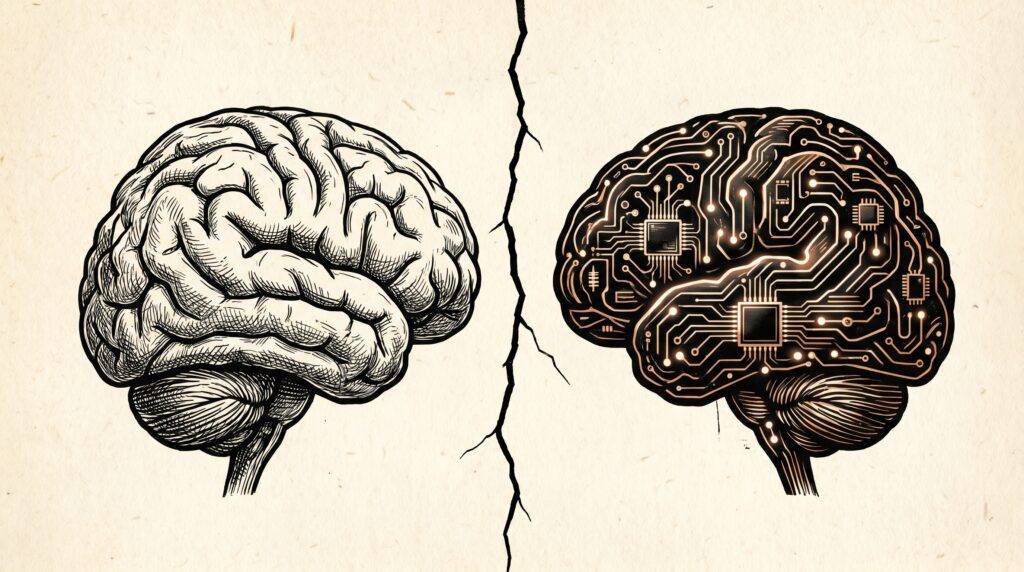
Which raises the question that sits at the center of this entire conversation: what, precisely, is it that AI cannot do?
This question is harder to answer than it appears. The capabilities of frontier AI systems have expanded so rapidly that many confident answers from two years ago are already obsolete. Tasks that seemed safely human — writing, coding, image creation, legal research, medical diagnosis — have been substantially automated or augmented.
But there is a cluster of capabilities that remains genuinely resistant to automation, and understanding why helps clarify where human value is actually located.
**First: judgment under moral and ethical uncertainty.**
AI systems are extraordinarily good at optimizing toward specified objectives. They are not capable of determining which objectives should be specified, or of navigating situations where competing values create genuine tension that cannot be resolved by maximizing a single metric.
A doctor deciding how to tell a patient a terminal diagnosis is not solving an optimization problem. They are navigating a human situation that involves suffering, dignity, relationship, hope, and the particular character of the person in front of them. The “right answer” is not computable. It requires presence, wisdom, and the kind of moral attention that emerges from having genuinely inhabited human experience.
**Second: pattern recognition across domains that share no obvious structural similarity.**
The historian Niall Ferguson has written about “plagues and financial crises” — arguing that the most important intellectual contribution historians make is not accumulating facts but recognizing when a current situation structurally resembles a past one that most observers are not thinking about.
This kind of cross-domain analogical reasoning — the ability to see that a supply chain disruption in 2021 rhymes with a supply chain disruption in 1973 in ways that matter for how you should act now — is something AI systems struggle with precisely because the similarity is not surface-level. It requires a form of understanding that goes beyond pattern matching within a domain.
**Third: what we might call *authentic conviction*.**
AI systems generate plausible-sounding text. They do not have genuine beliefs, and sophisticated audiences can often detect this, even if they can’t articulate exactly what they’re detecting. The difference between a writer who actually believes what they’re saying and one who is producing a competent simulacrum of belief is subtle — but it compounds over time.
Organizations and individuals that build trust over years do so because people can sense genuine conviction behind the communication. This is not something that can be manufactured. It is the residue of actually having thought hard about things, changed your mind, and arrived at a position you have earned.
—
## The Mirror Nobody Asked For
Here is the uncomfortable implication of everything above.
If AI is exposing that much of what we called “skilled work” was actually sophisticated execution — pattern-matching and output generation within defined domains — then the solution is not to learn a new set of skills in the same category.
The solution is to develop the capacities that were always more important but rarely rewarded, because execution was the bottleneck: judgment, synthesis, genuine conviction, the ability to ask better questions, and the wisdom to know which problems are worth solving.
This requires a different relationship with knowledge than most of us were taught. Instead of consuming information to reproduce it, we need to consume information to *sit with it* — to let it complicate our existing views, to notice where it creates tension with other things we believe, to use it as material for thinking rather than as content to be passed along.
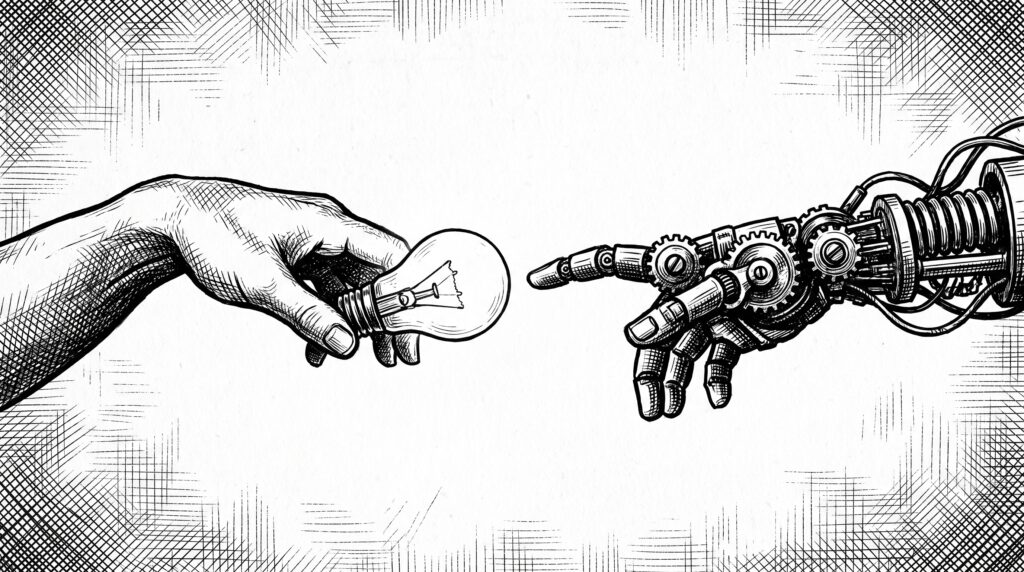
The irony is that AI makes this kind of thinking more accessible, not less. When the mechanical work of research, drafting, and formatting can be delegated to an AI assistant, the time and cognitive energy that were consumed by those tasks can theoretically be redirected toward the harder, more valuable work of actual thinking.
The people who will thrive in an AI-saturated environment are not the ones who learn to prompt most effectively. They are the ones who use AI-generated output as raw material for genuine intellectual engagement — who push back on it, stress-test it, combine it with things the AI didn’t have access to, and ultimately produce something that reflects a mind, not just a model.
—
## A Practical Framework for the Transition
None of this is to suggest that the transition will be painless or that good intentions are sufficient. The economic disruption is real, and it will fall unevenly — as all technological disruptions do — on the people least equipped to absorb it.
But for individuals who are trying to navigate this moment thoughtfully, a few principles seem durable.
**Invest in irreducible complexity.** The tasks that are hardest to automate share a common feature: they require integrating considerations that cannot all be made explicit. Choose work that requires you to hold multiple competing values simultaneously and make judgment calls that cannot be fully justified after the fact.
**Build a record of genuine thinking.** Not a portfolio of outputs, but evidence that you have actually engaged with hard questions — that you have changed your mind in public, that you have been wrong and said so, that your views on important topics have evolved in ways you can trace. This is what trust is built from, and trust is what AI cannot manufacture.
**Practice the deliberate use of uncertainty.** AI systems are trained to produce confident-sounding outputs. The human capacity to say “I don’t know, but here’s how I’m thinking about it” — and to be genuinely credible when saying so — is increasingly rare and increasingly valuable.
**Learn to read the situation, not just the text.** The most consequential human decisions are made in contexts where the relevant information is not in a document — it’s in a tone of voice, a pattern of behavior over time, a relationship dynamic that has history. Developing the sensitivity to read these contexts is not something that can be replaced by a system that has only ever processed text.
—
## What This Moment Actually Is
Frederick Taylor’s century is ending. The organizational logic that said “separate thinking from doing, and reward doing reliably” has run its course — not because someone decided it should, but because the doing has been automated.
What we are left with — what we are being called back to — is the harder, older, less legible work of actually thinking. Of forming genuine views. Of making judgments we are willing to stand behind. Of being present with other human beings in ways that cannot be systematized.
AI isn’t coming for your job. It’s exposing whether you were ever really doing it.
That’s not a threat. It’s an invitation — to finally do the work that was always more important.
—
*Time’s Ripple explores the ideas that shape how we live, work, and understand ourselves. If this piece challenged something you thought you knew, share it with someone who needs to read it.*
*Subscribe to the newsletter for one deep investigation, every week.*
—
**Further Reading:**
– Frederick Winslow Taylor, *The Principles of Scientific Management* (1911)
– Cal Newport, *Deep Work* (2016)
– Erik Brynjolfsson & Andrew McAfee, *The Second Machine Age* (2014)
– Robert Skidelsky, *How Much Is Enough?* (2012)