Disclosure: this article contains affiliate links. If you buy through them, Time’s Ripple may earn a commission at no extra cost to you. Product details come from the maker’s published product pages and policies, checked in October 2026. How this site handles affiliate links.
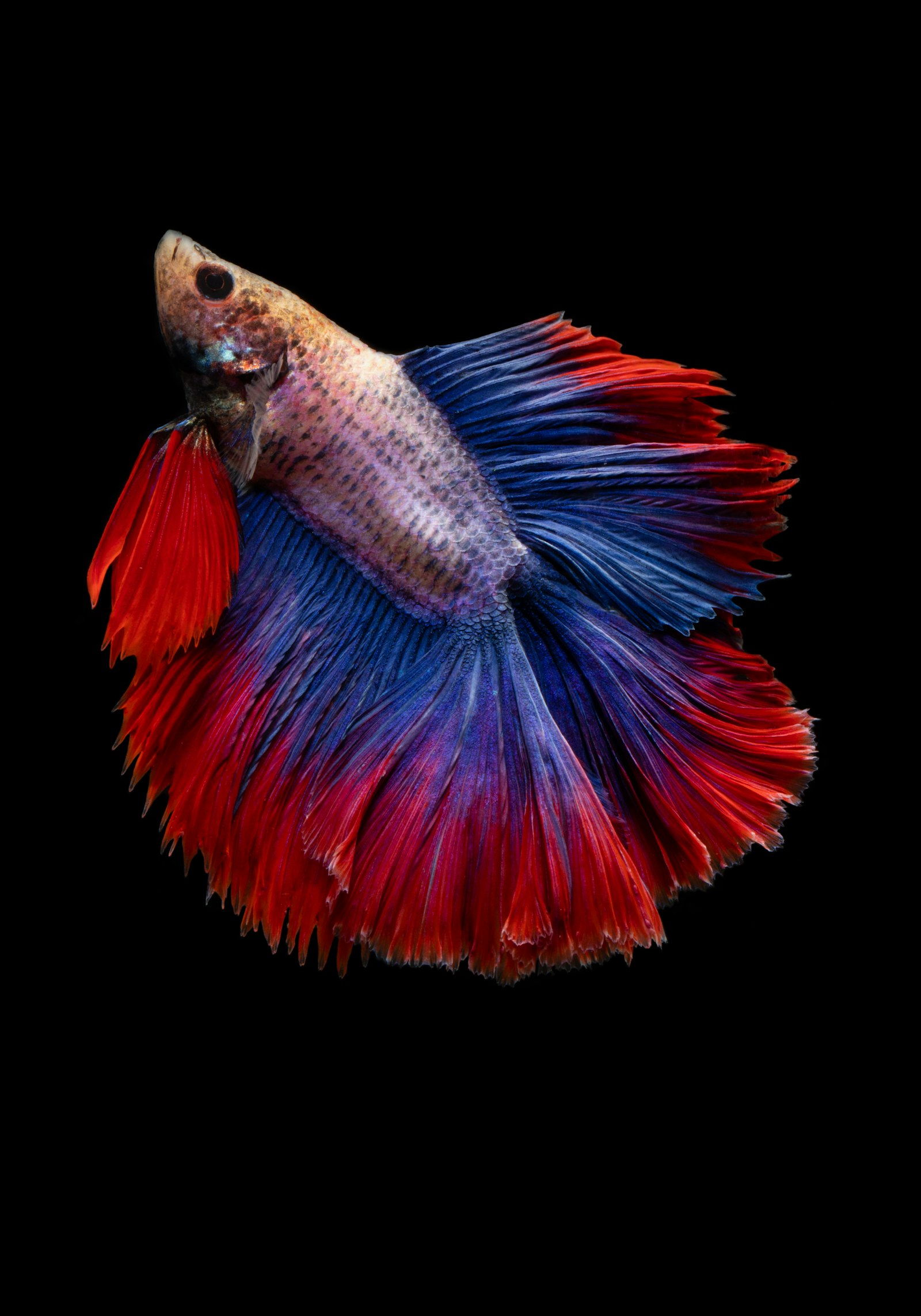
A betta fish heater is the piece of equipment beginners most often leave out, and the one that matters most after the tank itself. Bettas are tropical fish. They come from warm, shallow water in Southeast Asia, and most homes are cooler than the water they are built for, especially at night and in winter.
The heater is also cheap, small and easy to get wrong. Too weak and the tank never reaches a healthy temperature. Too strong, badly placed or never checked, and it can cook the water or fail without anyone noticing. In my betta fish tank setup guide I gave the heater one short section. This is the longer version.
It starts with whether a betta really needs a heater and the temperature to aim for. Then it covers how to size a heater to your tank, the types and safety features worth paying for, and where to put it. The last sections show how to check that it works and what to do when the power goes out. For a quick answer, the seven-point checklist near the end covers sizing, safety and placement.
The short answer
For most betta tanks of 3 to 10 gallons, choose an adjustable heater of about 25 to 50 watts. It should have a thermostat and a display outside the tank. Add a separate thermometer as well. Set it to about 78°F and check the thermometer morning and evening for the first week.
Links in this box are affiliate links. Prices and stock are from hygger’s US store on October 14, 2026 and change often. Full details and trade-offs are in the hygger section below.
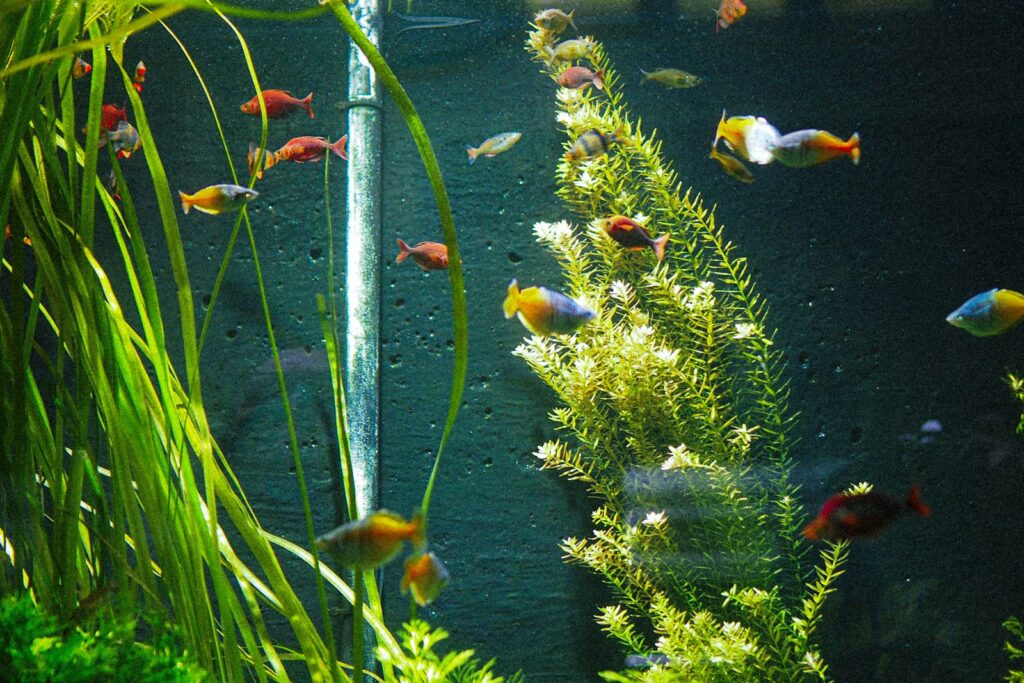
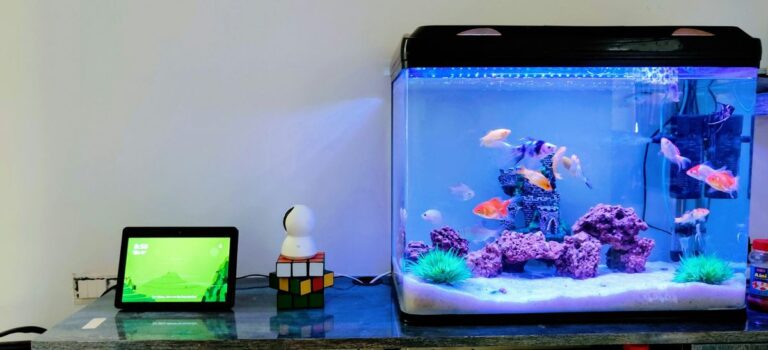
Most aquarium fish, bettas included, are tropical and do best in steady, warm water. Photo by J Cruikshank on Unsplash
Do betta fish need a heater?
In most homes, yes. Care guides commonly put the comfortable range for bettas at about 76 to 82°F (roughly 24 to 28°C). Many keepers aim for the middle of it, around 78 to 80°F. A room kept in the high 60s or low 70s, which is common in winter, will hold an unheated tank several degrees below that.
A betta will not usually die the first night in cool water. The problem is slower. Keepers commonly report that bettas kept too cool become sluggish, eat less, spend more time resting near the bottom and seem to fall ill more easily. Warm water is part of how a betta stays healthy, not a luxury.
The exception is a home that stays warm day and night, all year. Even then, a small tank follows the room. A sunny afternoon and a cold night can move the water several degrees in a day, and a heater with a thermostat smooths that out. That steadiness is the second reason to use one.
1. The right water temperature for a betta
Water temperature
What it means for a betta
Below about 74°F (23°C)
Too cool for long-term keeping. Activity and appetite usually drop.
About 76 to 82°F (24 to 28°C)
The range most care guides recommend.
About 78 to 80°F (25.5 to 26.5°C)
A common target, with room to spare on both sides.
Above about 84°F (29°C)
Warmer than needed. Warm water holds less oxygen, so keep it for short periods and only on advice.
Two points matter as much as the number itself. First, stability: a tank that sits at 78°F all day is better than one that swings between 74 and 82°F. Second, gradual change: when you adjust the setting, move it a degree or two at a time rather than all at once.
Some keepers raise the temperature slightly when a fish is unwell. That is a treatment decision, not a routine setting. If your betta looks sick, ask a vet with fish experience or a knowledgeable local fish store before changing anything.
2. Betta fish heater size: matching watts to your tank
Heaters are rated in watts and sold by tank size. A rule of thumb you will often see quoted is about 3 to 5 watts per gallon. The more useful number is the maker’s own chart, because it reflects how that particular heater is built. Size it by the water the tank actually holds, not the label on the box, since gravel, decorations and the gap under the lid all take up space. Our aquarium heater size calculator works that number out from your tank’s measurements and room temperature, and shows what the heater would cost to run.
Here is how one maker’s small heaters are sized, to show what a typical chart looks like:
Tank size (actual water)
hygger Alertness Nano Heater
hygger Tiny Titan Heater
hygger Digital Mini Heater
About 1 to 2.5 gallons
20W (1 to 5 gal)
15W (1 to 2.5 gal)
15W (up to 2.64 gal)
About 3 to 5 gallons
20W (1 to 5 gal)
25W (2 to 5 gal)
25W (up to 5.3 gal)
About 5 to 10 gallons
50W (5 to 10 gal)
50W (5 to 10 gal)
50W (up to 11.9 gal)
About 10 to 15 gallons
75W (10 to 15 gal)
100W (10 to 20 gal)
75W (up to 15.9 gal)
Two practical adjustments. If the room is much colder than the target, say a basement or a drafty window, lean toward the upper end of the chart. If your tank sits between two sizes, the larger heater with a thermostat is generally the safer choice. It reaches the set temperature and then switches off, so it is not running flat out all day.
Very small containers are the hardest to heat evenly. Even a small heater can push a one-gallon bowl too warm if the thermostat fails. That is one more reason the betta tank guide recommends at least 5 gallons of actual water.
3. Types of heater: preset or adjustable, glass or titanium
Preset heaters hold one fixed temperature, often around 78°F. They are simple, but you cannot change the setting, and you cannot see what the water is actually doing without a separate thermometer.
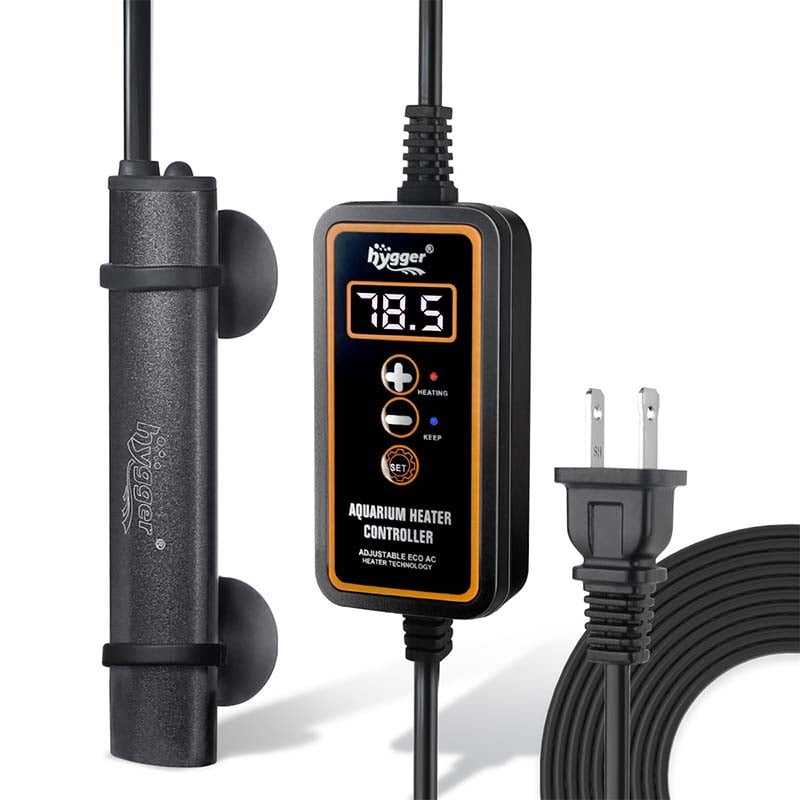
Adjustable heaters let you set the temperature. The newer small models put the control outside the tank, as a digital display or a dial on the cord. You can read and change the setting without putting your hands in the water.
The body is usually one of three things:
Quartz or glass: the most common type. It heats evenly but can crack if knocked, run dry or moved while hot.
Titanium or stainless steel: harder to break, often paired with a separate controller.
Any of the above inside a plastic guard: the guard keeps fish and decorations off the hot surface. Bettas like to rest on things, so a guard or a cool-touch shell is worth having.
4. Betta fish heater safety features to look for
A thermostat. The heater should switch off at the set temperature and back on when the water cools. Almost every adjustable model does this; cheap fixed “warmers” sometimes do not.
Automatic shut-off out of water. Some heaters stop heating when the water level drops or when they are lifted out. That protects the heater and the tank if you forget to unplug it during a water change.
Overheat protection. A cut-off if the water goes above a set limit, as a backstop for a stuck thermostat.
A readable display or indicator light. A light that shows when the heater is working lets you spot problems early.
Memory after a power cut. Some heaters keep their last setting when the power comes back, so you do not have to reset them.
A guard or smooth shell. Fewer places for a fish to get pressed against heat, and easier cleaning.
No feature replaces checking the water yourself. Thermostats fail, and the failure is usually silent from the outside.
5. Where to put the heater and how to set it up
Read the manual for the submersion rule. Requirements differ. One of the heaters below is designed to sit at least 5 inches below the water surface; another only needs its heating element covered. Get this right before anything else.
Place it in gentle flow. Near the filter outlet or intake, so warm water spreads through the tank instead of forming a hot spot. In a betta tank the flow should still be gentle.
Keep it off the substrate and away from decorations. Do not bury a heater in gravel or sand, and leave space around it.
Let it settle before plugging in. Many makers advise mounting the heater and waiting a little before switching on, so a glass tube can adjust to the water temperature. Check your manual for the exact time.
Set it, then wait a day. A new heater takes hours to bring a tank up to temperature. Adjust in small steps and judge by a separate thermometer, not by the dial.
Unplug it for water changes. Switch the heater off before the water level drops, and let it cool before you move it. One maker below asks for 15 minutes.
6. How to check that your heater is working
The display on a heater tells you what the heater thinks. A separate thermometer tells you what the fish feels. Makers commonly list an accuracy of about plus or minus 2°F for small heaters, which is enough to matter at the edges of a betta’s range.
Use a second thermometer on the opposite side of the tank from the heater. A stick-on digital thermometer or a glass one both work.
Check twice a day for the first few days: once in the morning, when the room is coolest, and once in the evening.
Watch the indicator light. On most models it shows heating and standby. If it is always on and the water is still cool, the heater may be too small for the tank or the room. If the water keeps climbing past the setting, unplug it and replace it.
Glance at it during routine care. A quick look at the thermometer whenever you feed takes seconds and catches a failure early.
7. Keeping a betta warm without a heater
Sometimes there is no heater: a power cut, a heater that fails on a weekend, or a fish that arrived before the equipment. Short-term measures help:
Keep the lid on and wrap the tank in a towel or blanket to slow heat loss.
Move a small tank to the warmest room, away from windows and drafts.
Do not pour hot water into the tank or put a heated object in it. Sudden changes are more dangerous than slow cooling.
Replace the heater as soon as you can, and keep a spare if you live somewhere with cold winters.
These are stopgaps. A betta can live for a while in room-temperature water, but it is not the setup to plan around. For more ways to slow heat loss, and what a heater actually adds to your electric bill, see how to keep a fish tank warm without a heater.
The heaters below are from hygger. I chose them because each of the three has a wattage chart by tank size on its product page. That chart is the first thing to check on any heater. Other brands sell good small heaters too, and the same questions apply to them.
Shipping and returns
hygger ships free to most of the United States, though not to Alaska, Hawaii, US territories, P.O. boxes or APO/FPO addresses. Its return policy says anything damaged in transit is replaced automatically. If you change your mind, an unused heater in its original box can go back within 30 days. You pay the return shipping. Check the warranty page before you rely on it; my betta tank setup guide summarizes the full terms.
Three small hygger heaters for a betta tank
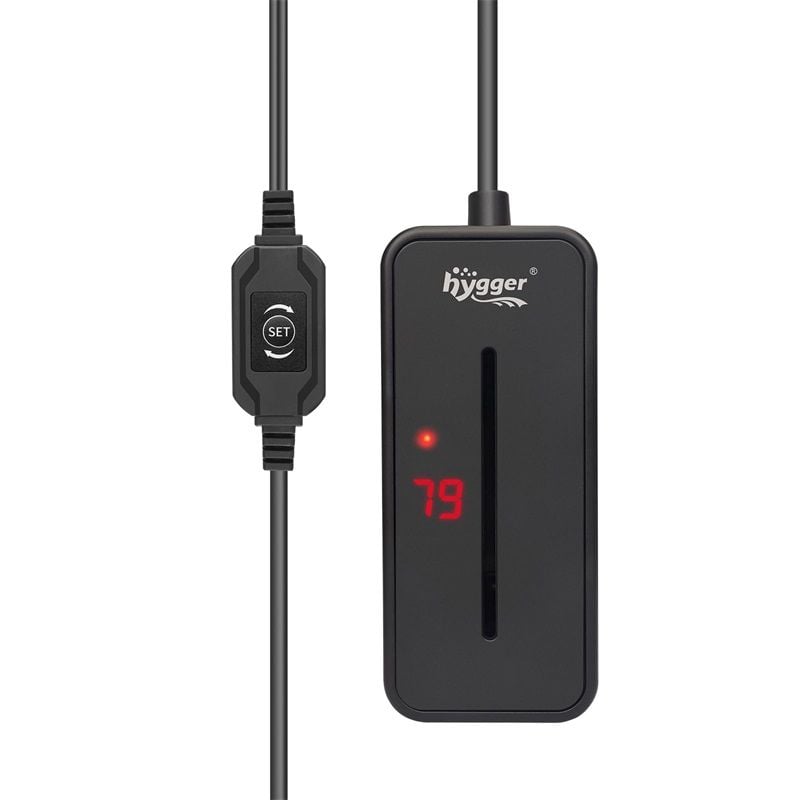
If safety alerts matter most: the Alertness Nano Heater (model HG142), from $17.99 to $21.99 depending on wattage. It comes in 20 watts for 1 to 5 gallons, 50 watts for 5 to 10 gallons and 75 watts for 10 to 15 gallons. It has an external digital controller with a real-time temperature display and a setting range of 59 to 93°F. The maker says it shuts off and sounds an alarm with an error code if the water level drops too low or the temperature goes out of range. It also says the heater remembers its setting after a power cut. It is meant to sit at least 5 inches below the surface, in moderate flow, and is for freshwater only. It had 17 reviews averaging 5.0 on the maker’s site, and the 50-watt version was out of stock when I rechecked on October 14, 2026. Check current price and stock.
If you want a guard and a low profile: the Tiny Titan Water Heater (model HG045), from $17.99 to $22.99. Sizes: 15 watts (1 to 2.5 gallons), 25 watts (2 to 5), 50 watts (5 to 10) and 100 watts (10 to 20 gallons). It is a flat unit about 4.3 by 1.8 by 0.9 inches, with a detachable plastic guard over the heating element and two suction cups. An external knob sets the temperature from 59 to 93°F in one-degree steps, and an LCD shows the water temperature. The maker says it shuts off when taken out of water. It had 11 reviews averaging 5.0. Check current price.
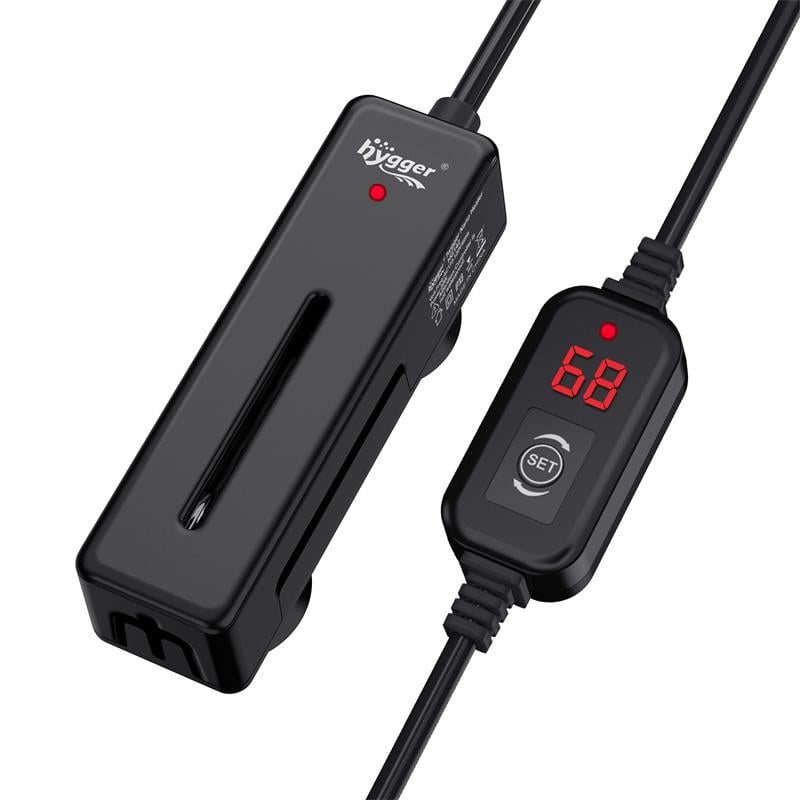
If you want a simple digital display: the Aquarium Digital Mini Heater (model HG083), from $17.99 to $20.99. Its 15, 25, 50 and 75-watt versions suit tanks up to about 2.6, 5.3, 11.9 and 15.9 gallons. Its external controller sets 68 to 90°F and shows the current temperature, with a red light while heating and a blue light at the set temperature. The shell is stainless steel with a Teflon coating, and it also remembers its setting after a power cut. The maker gives its display accuracy as plus or minus 2°F. It is the most reviewed of the three, with 30 reviews averaging about 4.8 on October 14, 2026. Check current price.
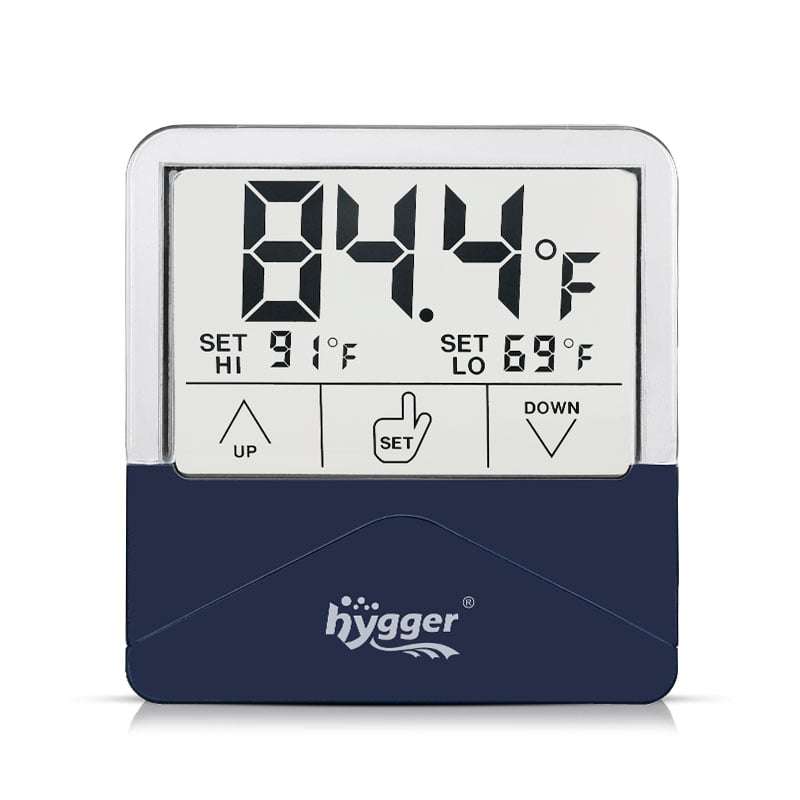
For checking any of them, the maker also sells an External Aquarium Thermometer (model HG073) for $13.99 to $15.99. It sticks to the outside of the glass and runs on a button battery, with a spare included. One version flashes its display when the temperature leaves a range you set (it does not beep); the other records the minimum and maximum.
Alertness Nano HeaterTiny Titan Water HeaterDigital Mini HeaterExternal Aquarium ThermometerImages: hygger, from its product pages.
All three heaters have clear wattage charts by tank size and external controllers. The Alertness model adds dry-run protection with an audible alarm. Against that, review counts are modest, at 11 to 30 per heater on the maker’s site, and setting ranges differ between models. The Digital Mini’s stated accuracy of plus or minus 2°F means you still want a separate thermometer. The 50-watt Alertness was out of stock on October 14, 2026, so check stock for your size before you plan around it.
If this is not the right fit
If you never want to touch a setting, a preset heater fixed near 78°F is the simplest option. Pair it with a thermometer, because you cannot adjust it if the room is unusually cold.
For a larger planted tank or a community tank, a full-size adjustable heater or a titanium heater with a separate controller gives you more headroom.
If the tank is for shrimp rather than a betta, a heater is often optional, since cherry shrimp are comfortable in the low to mid 70s. My shrimp tank setup guide explains when one helps.
If your betta is still in a bowl, the heater is not the first purchase. A tank of at least 5 gallons with a gentle filter comes first; my setup guide walks through it.
If you are buying locally, a fish store can show you heaters in person and often stocks the same sizes. Ask which ones it sees returned least often.
Betta fish heater checklist
I know how many gallons of water my tank actually holds.
The heater’s wattage matches that volume on the maker’s chart, with a step up if the room runs cold.
It has a thermostat, and ideally an external display or dial I can read without opening the tank.
It has a guard or a smooth shell, and some form of shut-off protection.
I know the maker’s submersion rule and where it will sit in gentle flow, off the substrate.
I have a separate thermometer and a plan to check it twice a day for the first week.
I will unplug the heater before every water change.
Frequently asked questions
Can betta fish live without a heater?
For a short time, yes. Over months, a betta in water below its comfortable range is commonly reported to be less active and more prone to illness. Unless your home stays around 76 to 82°F day and night, use a heater.
What temperature should a betta tank be?
Most care guides recommend about 76 to 82°F (24 to 28°C), and many keepers aim for 78 to 80°F. Keeping the temperature steady matters as much as the exact number.
What size heater do I need for a 5-gallon betta tank?
Small heaters for 5-gallon tanks are usually rated around 20 to 25 watts, and some makers list 50 watts for 5 to 10 gallons. Check the chart for the specific heater, and size it by the water the tank actually holds.
How do I know if my betta fish heater is working?
Watch the indicator light, which on most models shows heating or standby, and check a separate thermometer morning and evening for the first few days. If the water stays cool with the light always on, or climbs past the setting, the heater is undersized or faulty.
Should a betta fish heater stay on all the time?
Yes, it stays plugged in. A heater with a thermostat switches itself on and off to hold the set temperature. The exception is water changes: unplug it before the water level drops.
Warm, steady, checked
A good betta heater is small, correctly sized, placed where the water moves, and checked with a thermometer often enough that you would notice if it stopped. Get those four things right and it becomes one of the few pieces of equipment you can stop thinking about.
Photos: Kyaw Tun and J Cruikshank on Unsplash; they show bettas and planted tanks in general, not the products in this article. Product images: hygger. Product details: hygger’s product pages, checked on October 9, 2026, with prices, stock and review counts rechecked on October 14, 2026. Policies: hygger’s shipping policy, terms of use and warranty page, checked on October 8, 2026. Temperature ranges are widely used guidelines for keeping bettas, not rules; if your fish seems unwell, ask a vet with fish experience or a local fish store.
M. Caelestis is the pen name of the editor of Time’s Ripple. Aquarium articles here are researched from manufacturers’ product pages and policies, widely used fish-care guidelines and public reviews, and checked against those sources on the date given in each article. Products are not hands-on tested unless an article says so.