Ich on Fish: How to Spot It, Treat It and Keep It Out
Ich on fish shows up as tiny white spots. How the parasite lives, why one dose is never enough, how heat and salt fit in, and how to keep it out of your tank.
This guide has no affiliate links. The facts in it come from University of Florida and Southern Regional Aquaculture Center fact sheets, listed at the end.
Ich on fish usually announces itself as tiny white dots, as if someone had sprinkled salt over the body and fins. The cause is a single-celled parasite, Ichthyophthirius multifiliis, and the disease it causes is also called white spot. Ich is common, it can kill many fish in a short time, and it is very treatable when you catch it early and understand how it lives.
That last part matters most. The white spots are the one stage that medicine cannot reach, so a single dose almost never works. This guide explains the life cycle in plain terms, how to tell ich from look-alikes, how the common treatments work, and how to stop the parasite from getting into your tank in the first place.
Near the end, a seven-point checklist sums up what to do on the day you see the first spots, and the FAQ answers questions such as whether ich can spread to people.
The short answer
Treat as soon as you are confident it is ich, and treat repeatedly. The parasite is only vulnerable in the water, between leaving one fish and burrowing into the next, so treatments have to be timed to catch each new wave. In warm tanks that means daily treatment for several days, and you continue until the spots are gone and no more fish die. Clean debris from the bottom, quarantine new fish for at least 30 days, and ask an aquatic vet or experienced store if fish keep dying.
Water temperature
How often to treat (SRAC guide)
75°F and higher
Every day
65 to 74°F
Every other day
55 to 64°F
Skip 2 days between treatments
45 to 54°F
Skip 3 or 4 days between treatments
Intervals from Southern Regional Aquaculture Center Publication 476, written mainly for fish farms. Always follow the label of the product you use.
Ich is a protozoan: a single-celled parasite covered in tiny hairs called cilia. SRAC describes it as an obligate parasite, which means it cannot complete its life without a fish to feed on.
The mature parasite can reach about 1 mm across, according to the Southern Regional Aquaculture Center (SRAC), large enough to see without magnification. Each white spot is a parasite feeding under the outer layer of skin or gill tissue. SRAC states that all species of freshwater fish can carry it.
The gills are where ich does the most harm. SRAC explains that the gill surface thickens in response to the parasite, the fine gill folds become deformed, and large numbers of parasites physically block oxygen transfer. Damaged skin and gills also let bacteria and fungi in more easily.
2. The ich life cycle, and why one dose is not enough
Ich has three main stages, and only some of them can be killed.
Stage
Where it is
Can treatment reach it?
Trophont (the white spot)
Feeding under the fish’s skin or gill tissue
No. Mucus and tissue shield it
Tomont (cyst)
Dropped off the fish, stuck to glass, gravel, plants or decor, dividing into many new cells
SRAC lists it as sensitive; UF/IFAS describes it as protected
Theront (swimmer)
Free in the water, searching for a fish
Yes. This is the main target
The University of Florida’s IFAS extension fact sheet describes each cyst dividing up to ten times to release up to 1,024 new cells, a step that takes 18 to 24 hours at 74°F. SRAC puts the count as high as 2,000. The swimmers must find a fish quickly: SRAC says they usually die within a day or two without a host.
Temperature sets the pace. SRAC reports that the full cycle takes less than four days above 75°F and more than five weeks below 45°F, and that infections are most common between 68 and 77°F.
This is why a single treatment fails. On day one, the medicine kills the swimmers that happen to be in the water. The parasites still under the skin are untouched. A day or two later they drop off, divide and release a new wave, and that wave needs another treatment. SRAC estimates that three to seven treatments may be needed to catch every parasite at a vulnerable stage.
3. Signs of ich, and what can look like it
UF/IFAS and SRAC describe these signs:
Small white spots on the skin and fins, like grains of salt. The skin may look bumpy.
Flashing: fish rub or scratch against rocks, decor or the gravel, often before spots are visible.
Extra mucus, which can make the body look cloudy or fuzzy from a distance.
Reduced appetite, weakness and less activity. Infected fish often stop eating.
Fast or labored breathing. In gill-only infections there may be no spots at all, just pale, swollen gills and fish dying.
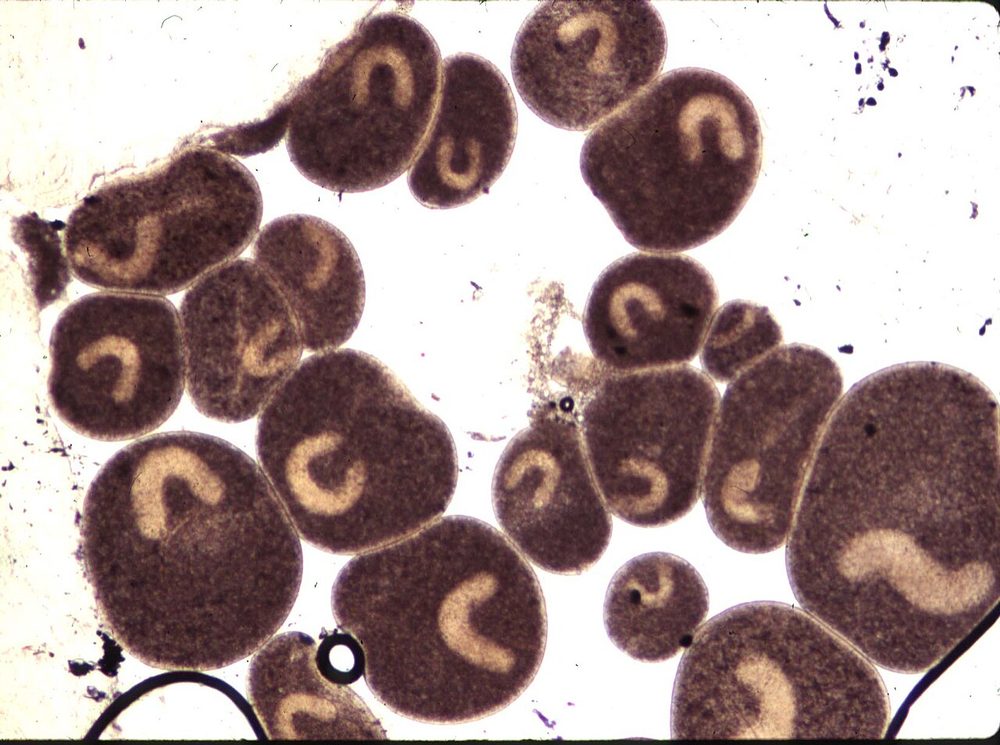
Spots can be hard to see on pale fish. UF/IFAS also warns that white spots alone should not be used to diagnose ich, because other diseases look similar. A confirmed diagnosis comes from a skin or gill sample under a microscope, where the mature parasite shows a horseshoe-shaped nucleus and rolls slowly as it moves. If you have no microscope, an aquatic veterinarian or a fish store with diagnostic experience can check a sample.
Mature ich parasites under a microscope. The horseshoe-shaped nucleus is the feature UF/IFAS describes for confirming a diagnosis. Photo: Andy Goodwin/USFWS, via Wikimedia Commons, CC BY 2.0.
4. How ich gets into a tank
The most common route is a new fish. UF/IFAS notes that fish can carry the parasite without showing signs, and that disease often appears one to three weeks after fish are shipped at warm temperatures.
Cysts can also travel on equipment. UF/IFAS lists unsanitized nets, siphon hoses and plants, and even water splashed between tanks. If you keep more than one tank, give each its own net and hose, or disinfect and dry them between uses.
Condition matters too. SRAC notes that well-nourished fish resist ich better and that starved, thin fish are commonly infected.
5. How to treat ich on fish
The steps below follow the UF/IFAS and SRAC fact sheets, adapted to a home aquarium. Fish farms use bulk chemicals and doses that are not suitable for a home tank, so for medication use a product made for aquarium ich and follow its label exactly. SRAC warns that adding extra “for good measure” can kill or stress fish, while underdosing may not kill the parasite.
Act quickly. UF/IFAS advises medicating as soon as the parasite is confirmed, because heavily infected fish may not survive treatment.
Treat the whole tank. The swimmers are in the water and the cysts are on the decor, so moving only the spotted fish leaves the problem behind.
Read the active ingredient. UF/IFAS describes formalin for tanks, with a half dose for formalin-sensitive species, and copper mainly for ponds. Copper is dangerous if overdosed, and both sources say not to use it in water with low total alkalinity (UF/IFAS: below 50 mg/L). SRAC says goldfish need a reduced copper dose. Copper products commonly warn against use with shrimp and snails, so check the label if your tank has them.
Prepare the filter. Many ich medication labels say to remove activated carbon, which can absorb the medicine. Some treatments can also harm the filter bacteria; the fish tank cycling guide explains why to test ammonia and nitrite more often while you medicate.
Add air. UF/IFAS advises vigorous aeration during formalin treatment, and gill damage from ich already makes breathing harder.
Repeat on schedule. At 75 to 79°F, UF/IFAS recommends daily treatment with a minimum of three to five treatments. Use the temperature table in the short answer above for cooler water.
Clean the bottom. Cysts stick to debris. UF/IFAS recommends removing organic debris after treatment and, for pet fish, cleaning the tank every other day. Vacuum the gravel and remove dead fish promptly.
Keep going until it is over. UF/IFAS says to continue until all deaths stop. Visible spots disappearing is a good sign, but the parasite may still be in the tank.
If fish keep dying after a full course, stop guessing. Something else may be going on alongside ich, and an aquatic vet can examine a sample.
6. Heat and salt: what the research says
Raising the temperature
Many hobbyists raise the tank temperature to fight ich, and there is a basis for it. SRAC reports that ich typically cannot reproduce properly above 85°F. Higher temperatures also speed up the life cycle, so the parasite reaches its vulnerable stage sooner.
There are two limits. First, heat is not a guaranteed cure: SRAC also records a case in central Florida where ich killed fish at 92°F. Second, not every fish, plant or shrimp tolerates water that warm, and warm water holds less dissolved oxygen, so add aeration. Check what your species can take before raising the heat, raise it gradually, and treat heat as a support for a proper treatment course. For betta keepers, the betta fish heater guide covers how to set and check temperature.
Salt
UF/IFAS describes salt (sodium chloride) at 4 to 5 grams per liter, about 15 to 19 grams per US gallon, for 7 to 10 days at 75 to 79°F, in smaller systems and only for species that tolerate it. The swimmers cannot tolerate 3 to 5 parts per thousand. UF/IFAS adds that most freshwater fish tolerate 5 parts per thousand for several weeks, but some do not, and some plants do not tolerate salt either.
Salt is not foolproof. SRAC records cases where ich tolerated 3 parts per thousand, and one where it survived 5. Weigh the salt, dissolve it in tank water before adding it, and remember that water changes remove salt, so you only replace what you take out.
7. After treatment: recovery and carriers
Fish that survive ich often need time to heal. UF/IFAS advises watching recovering fish for secondary bacterial infections, because the parasite leaves damaged skin and gills behind. Keep water quality high and feed lightly with good food while they recover.
Survivors can also become carriers. UF/IFAS notes that they may hold low-level infections without visible signs and pass the parasite to fish that have never met it. That is one more reason to quarantine new fish, and to avoid moving fish from a recently infected tank into a healthy one.
8. How to keep ich out
Quarantine every new fish for at least 30 days, as UF/IFAS recommends, in a separate tank with its own equipment.
Look before you buy. Skip tanks at the store with spotted, flashing or dead fish.
Do not share nets, hoses or buckets between tanks without disinfecting and drying them.
Treat new plants and decor with care. UF/IFAS suggests disinfecting them or holding them away from fish long enough for any parasites to die off.
Keep fish well fed and the water stable. A healthy fish in a cycled tank is better equipped to fight off infection.
Spots plus flashing or lost appetite: test the water and look closely at every fish.
Confirm with a microscope or a knowledgeable store if you can; white spots alone are not proof.
Treat the whole tank with an aquarium ich product, at the labeled dose.
Repeat on schedule: daily at 75°F and above, less often in cooler water.
Remove carbon if the label says so, add aeration, and test ammonia and nitrite.
Vacuum debris and remove dead fish; give each tank its own equipment.
Keep treating until deaths stop, then quarantine all new fish for 30 days.
Frequently asked questions
Can fish survive ich?
Yes, especially when treatment starts early. Heavy infections are harder: UF/IFAS warns that severely infected fish may not survive treatment, and SRAC notes that ich can kill large numbers of fish quickly. Watch survivors for secondary infections.
Can ich spread to humans?
No. SRAC states that ich poses no human health risk because it does not infect people. It is still worth washing your hands after working in any aquarium.
Is ich fungal or bacterial?
Neither. Ich is a protozoan parasite. The heavy mucus it causes can look like fungus from a distance, and bacteria or fungi can invade skin it has damaged, but the cause is the parasite.
Can ich survive without fish?
Not for long. The free-swimming stage usually dies within a day or two if it finds no fish, according to SRAC. Cysts already on surfaces can still release swimmers, and in cool water that takes longer, so an empty tank needs time and warmth to clear. SRAC describes leaving a pond fish-free for a week or more above 45°F.
How long does it take to get rid of ich?
It depends on temperature. Above 75°F the life cycle runs in under four days, and UF/IFAS gives a minimum of three to five daily treatments at 75 to 79°F. In cool water the cycle stretches to weeks, so treatment takes longer. Continue until deaths stop, as UF/IFAS advises, not just until the spots fade.
Can you cure ich naturally?
Heat and salt are the methods people usually mean. Both have research behind them, and both have limits: some ich has survived 92°F and 5 parts per thousand of salt, and many fish and plants cannot tolerate those conditions. They work best as part of a planned course, with repeated treatment and daily cleaning.
Why does ich keep coming back?
Usually because treatment stopped too early, the parasite survived in debris, or a carrier fish or new fish brought it back. Recovered fish can carry low levels of ich without signs, as UF/IFAS notes.
Catch it early, treat it patiently
Ich rewards keepers who look at their fish every day. The first flashing fish or a few white grains on a fin is the moment to act. Treat on a schedule, clean as you go, keep at it until the losses stop, and quarantine whatever comes next.
M. Caelestis is the pen name of the editor of Time’s Ripple. Aquarium articles here are researched from manufacturers’ product pages and policies, widely used fish-care guidelines and public reviews, and checked against those sources on the date given in each article. Products are not hands-on tested unless an article says so.