This guide has no affiliate links. Every figure in it comes from a university extension service, an animal welfare body or a peer-reviewed study, listed at the end.
If you want to know how to cycle a fish tank, the short version is this: you grow a colony of bacteria that turns toxic fish waste into something far less harmful, and you wait until a water test proves the colony is big enough before you add fish. A new aquarium has none of these bacteria. The RSPCA calls a missing biological filter the number one cause of fish deaths in aquariums, particularly new ones.
This guide covers both ways to do it. The fishless method builds the bacteria before any animal goes in. The fish-in method keeps a few hardy fish alive while the bacteria catch up. You will also see how long cycling takes, how to read the test results, and what to do when the numbers stop moving.
At the end there is an eight-point checklist you can keep next to the tank while you cycle, followed by answers to the questions people search most, such as whether a tank can cycle in a week.
The short answer
Set up the tank with its filter and heater running and treat the tap water with a conditioner that handles chlorine and chloramine. Then add a source of ammonia: a measured dose of pure ammonia for a fishless cycle, or a few hardy fish fed lightly for a fish-in cycle. Test ammonia, nitrite and nitrate every few days. The tank is cycled when ammonia and nitrite both read zero while nitrate keeps showing up. Most guides put this at four to eight weeks.
Stage
What the test shows
Typical timing
1. Ammonia builds
Ammonia rises; nitrite and nitrate read zero
From the first days
2. Nitrite appears
Ammonia starts to fall; nitrite climbs
Often the second week
3. Nitrate appears
Nitrite falls; nitrate climbs
Weeks three to six or later
4. Cycled
Ammonia 0, nitrite 0, nitrate present
Four to eight weeks in most guides
Timings come from RSPCA and University of Florida guidance and vary from tank to tank. Trust the test kit, not the calendar.
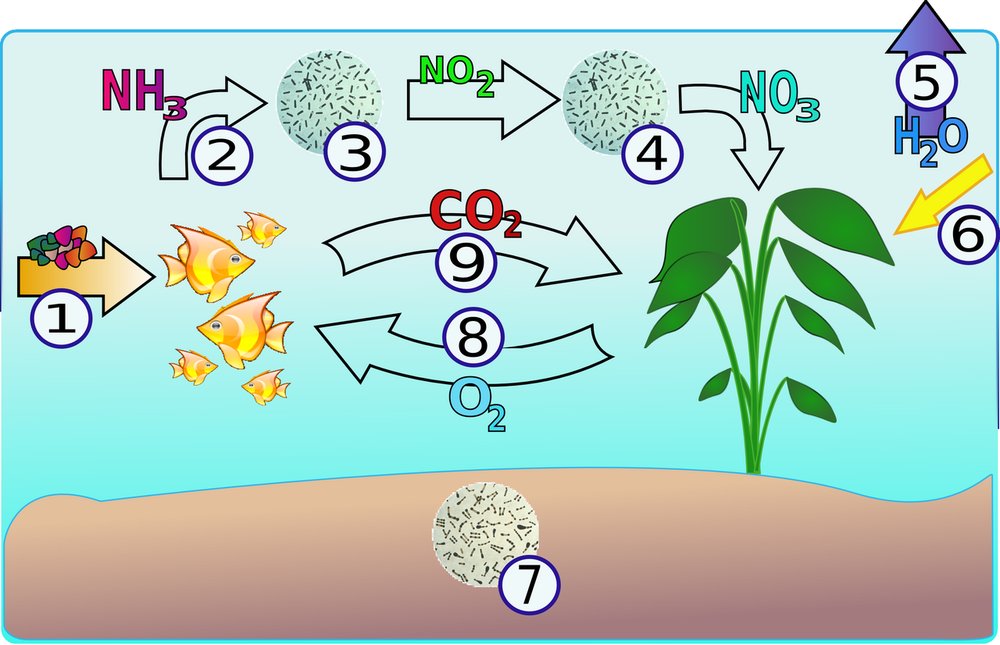
The nitrogen cycle in an aquarium: fish waste releases ammonia (NH3), bacteria turn it into nitrite (NO2) and then nitrate (NO3), and plants take up some of the nitrate. Diagram by Lukas3, via Wikimedia Commons, CC BY 2.5.
1. What cycling a fish tank means
Fish release ammonia through their gills and in their waste, and uneaten food and dead plant matter add more as they rot. In a pond or river that ammonia is diluted and broken down. In a closed glass box it builds up.
The fix is nitrification, a two-step process carried out by microbes that live as a thin film on every wet surface in the tank, most of all inside the filter:
Step one: ammonia-oxidizing microbes turn ammonia (NH3/NH4+) into nitrite (NO2-).
Step two: nitrite-oxidizing bacteria turn nitrite into nitrate (NO3-).
The University of Florida’s IFAS extension fact sheet on ammonia names Nitrosomonas and Nitrosospira among the ammonia oxidizers and Nitrospira and Nitrobacter among the nitrite oxidizers. It describes nitrate as much less toxic than nitrite. Nitrate still matters in large amounts. It builds slowly, and partial water changes remove it.
“Cycling” simply means growing these populations until they can process all the ammonia your fish will produce. Until then, the tank has no way to get rid of the waste except your water changes.
Which microbes actually do the work
Older aquarium books credit Nitrosomonas and Nitrobacter. Research on real home tanks found a different picture. A 1998 study in Applied and Environmental Microbiology (Hovanec and colleagues) did not detect Nitrobacter in freshwater aquarium biofilms and linked the start of nitrite removal to Nitrospira-like bacteria instead. A 2011 study in PLOS ONE (Sauder and colleagues) found that ammonia-oxidizing archaea, not bacteria, were the more numerous ammonia oxidizers in 23 of 27 freshwater aquarium filters it sampled.
You do not need to know the species to cycle a tank. The research matters for one practical reason, covered in section 6: a bottle of bacteria is not guaranteed to contain the organisms that end up running your filter.
2. Why an uncycled tank is dangerous (new tank syndrome)
“New tank syndrome” is the hobby name for what happens when fish go into a tank before the bacteria exist. The RSPCA describes the usual pattern: ammonia climbs from about the third day after fish are added, and nitrite climbs during the second week. Any fish already in the tank spend those weeks in water that is slowly poisoning them.
Ammonia comes in two forms. The ionized form (NH4+) is relatively mild. The un-ionized form (NH3) is, according to UF/IFAS, roughly 100 times more toxic to fish. Which form dominates depends mainly on pH and temperature: the higher either one goes, the larger the toxic share. Most test kits report total ammonia, so the same reading can be mild in one tank and dangerous in another.
Water
Share of total ammonia in the toxic NH3 form
Toxic NH3 in a 1 ppm total ammonia reading
pH 7.0, 75°F (24°C)
0.52%
about 0.005 ppm
pH 7.0, 90°F (32°C)
0.93%
about 0.009 ppm
pH 8.0, 75°F (24°C)
5.02%
about 0.05 ppm
pH 8.0, 90°F (32°C)
8.77%
about 0.09 ppm
The percentages come from Table 1 of the UF/IFAS ammonia fact sheet; the last column is that percentage applied to a reading of 1 ppm. UF/IFAS says tissue damage can occur any time un-ionized ammonia is above 0.05 mg/L (the same as 0.05 ppm). So in hard, alkaline tap water at tropical temperature, a total ammonia reading of 1 ppm is already at that line. The same fact sheet says nitrite can be toxic at levels as low as 0.10 mg/L.
The fact sheet also notes that fish kept in low levels of ammonia over time get more bacterial infections and grow poorly. In a healthy, cycled tank, ammonia should always read zero.
3. What you need before you start
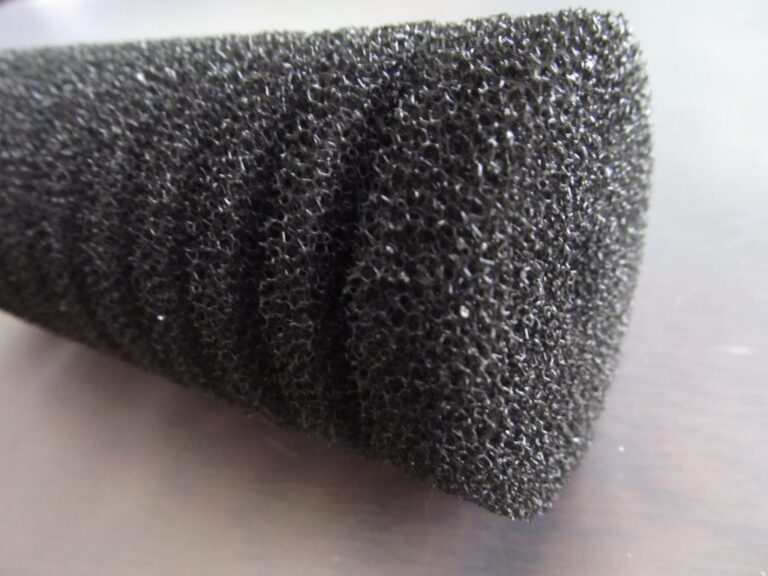
A running filter. The filter media is where most of the bacteria will live. Any type works; a sponge filter is a cheap, common choice for small tanks.
Heater set to the final temperature if you keep tropical fish, so the bacteria grow in the conditions they will work in. The heater size calculator helps you pick the wattage.
Water conditioner that treats both chlorine and chloramine. The Virginia Department of Health notes that freshwater and saltwater fish are sensitive to both and that a suitable additive should remove them before tap water goes into an aquarium. Some US utilities disinfect with chloramine, and Pinellas County, Florida, warns that unlike chlorine it may take weeks to disappear from standing water. Check that the label says chloramine.
A test kit for ammonia, nitrite, nitrate and pH. Liquid kits are the usual choice. UF/IFAS explains that most kits measure total ammonia nitrogen, and that kits using the Nessler method can give falsely high ammonia readings after ammonia-binding products or many water conditioners. Kits using the salicylate method are not affected by those products.
An ammonia source: pure ammonia for a fishless cycle, or a small number of hardy fish for a fish-in cycle.
4. How to cycle a fish tank without fish
The fishless cycle is the kinder method, because nothing has to live through the toxic weeks. Instead of fish waste, you feed the bacteria a measured dose of ammonia.
Fill and treat the tank. Add conditioned water, start the filter and set the heater.
Dose ammonia to about 2 ppm. Use ammonia or ammonium chloride sold for fishless cycling, or plain household ammonia whose label lists only ammonia and water, with no scent or surfactant. Aquarium Co-op’s instructions for bottled ammonium chloride aim for 2 ppm and warn that levels above 5 ppm may slow the cycle.
Test every one to three days. Write the numbers down. You are watching for ammonia to fall and nitrite to rise.
Keep feeding the bacteria. When ammonia drops close to zero, dose back to about 2 ppm. Dr. Tim’s Aquatics’ fishless cycling steps re-dose this way as long as ammonia and nitrite stay below 5 ppm.
Wait for nitrite to fall. This is usually the slow part. If nitrite climbs above 5 ppm and sits there, a partial water change brings it back down.
Run the 24-hour test. When you see nitrate and both ammonia and nitrite read zero, dose 2 ppm once more. If ammonia and nitrite are both back near zero (below about 0.2 ppm) within 24 hours, the bacteria can handle a real load.
Change water, then add fish. A large water change lowers the nitrate built up during cycling. Add fish within a day or two so the bacteria do not run out of food, and start with a modest number.
Two cautions. Turn off any UV sterilizer during the cycle; Dr. Tim’s instructions say to switch off UV and ozone until the first cycle is done. And do not dose ammonia into a tank that already holds fish, shrimp or snails.
5. How to cycle a fish tank with fish in it
Sometimes the fish are already in the tank, because a store sold them with the tank or because you did not know about cycling. You can still cycle the tank; the job becomes keeping ammonia and nitrite low while the bacteria grow.
Keep the stock small. The RSPCA advises against adding large numbers of fish at once so the bacteria can keep up. A few hardy fish is the limit until the tank is cycled.
Feed lightly. Less food means less ammonia. UF/IFAS notes that reducing or stopping feeding for a short period, such as one to three days, typically does not harm fish (fry are the exception).
Test every two to three days for the first six weeks, as the RSPCA recommends.
Change water whenever ammonia or nitrite shows up. The RSPCA suggests partial changes of 10 to 25 percent every two to three days while levels rise; UF/IFAS describes 25 to 50 percent changes to lower ammonia. Match the new water’s temperature and treat it with conditioner first.
Check pH as well as ammonia. Use the table in section 2. At pH 8 a reading that looks small carries ten times the toxic share it would at pH 7.
Water changes do not throw the bacteria away. They live on surfaces and in the filter, not floating in the water you remove.
Watch the fish. UF/IFAS lists reduced feeding as a sign that warrants an immediate water test. Gasping at the surface, clamped fins or lethargy are reasons to test and change water the same day. If fish keep getting sick, an aquatic veterinarian or an experienced local fish store is the right next step.
In fish farming, salt is used to protect fish from nitrite because chloride competes with nitrite at the gills (Southern Regional Aquaculture Center Publication 462). That guidance is written for ponds. Some aquarium fish, shrimp, snails and plants handle salt poorly, so ask a vet or experienced store before trying it in a home tank.
6. How long it takes, and what speeds it up
The RSPCA puts a freshwater cycle at four to six weeks and says marine tanks take about twice as long. UF/IFAS says a new biofilter needs six to eight weeks to build enough bacteria. Faster results do happen, but plan for a month or more.
Four things change the pace:
Bacteria from a healthy, established tank. A squeezed-out sponge, a handful of filter media or gravel from a disease-free tank you trust brings a working population with it. Keepers use it widely to shorten a cycle. It can also carry parasites or snails, so use it only from a tank with no recent illness.
Alkalinity. Nitrification uses up alkalinity and pushes pH down. UF/IFAS says nitrifying bacteria do not function effectively below 20 mg/L total alkalinity, which is about 1 degree of carbonate hardness (dKH). Soft water can stall a cycle for this reason alone.
Oxygen and flow. The bacteria need oxygen. Keep the filter running at all times and make sure the water surface moves.
Bottled bacteria. Results vary. In the 1998 study, tanks dosed with a Nitrobacter product did not develop Nitrobacter. In the 2011 study, the two commercial supplements tested carried ammonia-oxidizing bacteria but no archaea, while archaea were the main ammonia oxidizers in most filters sampled. Products have changed since then, so judge any bottle by your own test results.
7. How to know your tank is cycled
The RSPCA’s definition is the one to use: when nitrate is being produced and ammonia and nitrite are both zero, the tank is fully cycled. For a fishless cycle, add the 24-hour test from section 4 as proof that the bacteria can handle a full dose.
After that, add fish in stages rather than all at once. Each new group raises the waste load, and the bacteria need a little time to grow to match. Test ammonia and nitrite a few days after each addition. Once things are stable, the RSPCA says testing every one to two weeks is enough, with 10 to 25 percent water changes each week.
Low alkalinity or pH, no oxygen flow, or chlorine/chloramine still in the water
Test pH and KH; check the filter runs nonstop; confirm the conditioner covers chloramine
Nitrite climbs and will not fall
Nitrite is often the slowest stage; very high ammonia or nitrite can slow it further
Do a partial water change to bring nitrite under 5 ppm; keep ammonia doses near 2 ppm
pH keeps dropping
Nitrification is using up alkalinity
Raise KH above about 1 dKH (20 mg/L); test KH weekly
Ammonia suddenly reads high in a cycled tank
A dead fish, overfeeding, medication or a cleaned filter
Remove the cause, change 25 to 50 percent of the water, cut feeding, test daily
Ammonia reads high right after a water change
Tap water containing chloramine or ammonia, or a Nessler kit reacting to conditioner
Test your tap water; compare with a salicylate kit
A “crash” means a cycled tank loses much of its bacteria. UF/IFAS warns that some disease treatments, especially antibiotics, can harm the biofilter, so test ammonia and nitrite more often after medicating. Cleaning filter media under tap water can strip the bacteria too, because chlorine and chloramine kill them; rinse media in old tank water instead. A long power cut that stops the filter starves them of oxygen.
Fish tank cycling checklist
Filter, heater and air or surface movement run 24 hours a day.
Every bucket of tap water is treated for chlorine and chloramine.
The test kit covers ammonia, nitrite, nitrate and pH, and results go in a notebook.
Fishless: ammonia stays near 2 ppm and never above 5 ppm.
Fish-in: few hardy fish, light feeding, water changes whenever ammonia or nitrite shows.
KH stays above about 1 dKH, so pH does not crash.
Cycled means ammonia 0, nitrite 0, nitrate present, and a 2 ppm dose cleared in 24 hours.
Fish go in gradually, with a test a few days after each addition.
Frequently asked questions
How long does it take to cycle a fish tank?
Usually four to eight weeks. The RSPCA gives four to six weeks for freshwater tanks and about twice that for marine tanks. UF/IFAS says a new biofilter needs six to eight weeks. Seeding with media from an established tank can shorten it.
Can a fish tank cycle in a week?
From a completely bare start, rarely. A tank seeded with plenty of mature filter media can be ready much sooner, because the bacteria arrive already grown. Whatever the method, the test results decide, not the date.
Does a fish tank need to be cycled?
Yes. Without the bacteria, ammonia and nitrite from fish waste build up with nowhere to go. The RSPCA names a missing biological filter as the leading cause of fish deaths in aquariums, especially new ones.
What happens if you don’t cycle a fish tank?
The tank cycles anyway, with the fish inside it. Ammonia usually rises within days and nitrite follows in the second week. Fish are stressed, damaged or killed unless you keep the levels down with frequent water changes, which is the fish-in method described above.
Can plants reduce ammonia in a fish tank?
Live plants use ammonium and nitrate as nutrients, so a well-planted tank takes some pressure off the bacteria. They are a help, not a replacement for cycling. Keep testing.
Can a fish tank cycle without a filter?
Bacteria grow on any wet surface, so some nitrification happens in any tank. A filter gives them far more surface area and a steady flow of oxygen-rich water, which is why almost every guide cycles the filter. Without one, the tank can handle much less waste.
What causes a fish tank cycle to crash?
Common causes are antibiotics or other medications, cleaning the filter media in tap water, replacing all the media at once, a long power cut, and pH falling as alkalinity runs out. Test ammonia and nitrite after any of these.
Patience is the whole trick
Cycling asks very little except time and a test kit. Give the bacteria a month or two, let the numbers tell you when they are ready, and add fish slowly. A tank that starts this way is much easier to keep stable for years.
M. Caelestis is the pen name of the editor of Time’s Ripple. Aquarium articles here are researched from manufacturers’ product pages and policies, widely used fish-care guidelines and public reviews, and checked against those sources on the date given in each article. Products are not hands-on tested unless an article says so.