Disclosure: this article contains affiliate links. If you buy through them, Time’s Ripple may earn a commission at no extra cost to you. Product details come from the maker’s published product pages and policies, checked in October 2026. How this site handles affiliate links.
The light is the engine of a planted tank. Filters keep the water clean and heaters keep it warm, but the plants grow, or fail to grow, on the energy that comes from the lid. That makes choosing a planted aquarium light one of the few aquarium decisions that is worth taking slowly.
It is also one of the most confusing. Product pages list watts, lumens, Kelvin, PAR, CRI, color channels and lighting modes. Most of those numbers either come from tests you cannot compare or do not mean what they appear to mean. In my guide to aquarium CO2 systems I suggested getting the light right before adding anything else. This is the guide to doing that.
It covers how much light your plants actually need and what the numbers on the box mean. Then it shows how to match a light to your tank’s length, depth and rim, and how long to run it. The last part covers reading the plants when something is wrong, where to buy and what to check in the fine print. Near the end, a checklist turns all of this into seven checks you can run against any light’s product page.
The short answer
Choose the plants first, then the light. Most beginner plants need only low to medium light, and a light that is too strong mostly grows algae. If you already know your tank, this is how one maker’s range lines up.
Stated depth of 15 to 18 inches (60W) or 20 to 24 inches (100W)
$115.99 to $135.99
Links in this box are affiliate links. Prices and stock are from hygger’s US store on October 14, 2026 and change often. Details and trade-offs are in the hygger section below.
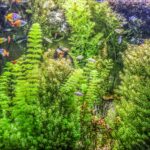
Plants grow on the energy that comes from the light. Photo by Josephina Kolpachnikof on Unsplash
How much light does a planted aquarium need?
Planted-tank keepers usually sort aquarium plants into low, medium and high light. Most beginner plants sit in the first group, and that matters, because a strong light over low-light plants does not make them grow faster. It mostly grows algae.
Amazon sword, water wisteria, most stem plants, vallisneria
About 30 to 50
Helpful but optional
High
Carpeting plants such as Monte Carlo and dwarf hairgrass, red stem plants
About 50 and above
Usually yes
The PAR figures are ranges commonly quoted by planted-tank keepers, not exact targets. The unit is micromoles of light per square meter per second at the bottom of the tank. They are useful mainly for comparing one light with another, if both are measured the same way.
A practical rule: choose the plants first, then buy the light that suits them. If you are not sure which plants you want, start with low-light species and a moderate light. It is much easier to add light later than to fight algae from day one.
1. What the numbers on a planted aquarium light actually mean
Number
What it measures
How much to trust it
Watts
Electricity the light uses
Only a rough guide. Two LED lights of the same wattage can produce very different amounts of light
Lumens
Brightness as the human eye sees it
Weighted toward green light, which looks bright to us but is not what plants use most
PAR
The light plants can use for photosynthesis, at a given point
The most useful figure, but only if the listing says at what depth or distance it was measured
Kelvin (K)
Color temperature of the white light
About 6,500 to 7,000 K looks natural and is a common choice for planted tanks
CRI
How naturally colors look under the light
Affects how fish and plants look to you, not how well plants grow
Spectrum or color channels
The mix of white, red, blue and other LEDs
Red and blue drive photosynthesis; separate channels let you tune the look
The single most common trap is a PAR figure with no depth attached. Light falls off quickly as it travels through water. A reading taken an inch below the fixture can be several times higher than the same light delivers to plants a foot below. If a listing gives PAR without saying where it was measured, treat it as a marketing number.
2. Match the light to the tank: length, depth and shape
Length. A bar light should cover most of the tank’s length, or the ends will be dim. Brands sell most bar lights by tank length, often with extendable brackets. Measure the outside length of the tank, including the rim, before ordering.
Depth. Depth matters more than most buyers expect. A light that grows carpeting plants in a 12-inch-tall tank may struggle at the bottom of a 20-inch one. If your tank is tall, look for a light that states its useful depth or penetration, and expect to need a stronger fixture than the length alone suggests.
Shape. Long, shallow tanks suit bar lights. For cube and square tanks, a pendant or spotlight-style fixture that spreads light in a cone often works better.
Tank
Common light style
Watch out for
Nano, 2 to 10 gallons
Small clip-on or gooseneck light
Glass thickness the clip accepts; too much light for a tiny tank
Standard rectangle, 10 to 75 gallons
Bar light on brackets across the rim
Ordering by gallons instead of length
Cube or square, rimless
Pendant or arm-mounted spotlight
Mounting arm limits; fan noise on stronger units
Tall tank, 20 inches or deeper
Stronger bar or high-output spotlight
Dim substrate even when the surface looks bright
3. Check how a planted aquarium light mounts
This is the detail that most often leads to returns. Rimmed tanks have a plastic frame that bar-light legs sit on. Rimless tanks need either legs that grip the glass edge or a clip or arm, and every clip has a maximum glass thickness. Measure your glass with a ruler before you buy, and compare it with the number on the listing.
Also check the cable length and whether the power adapter sits on the floor or hangs off the tank. A drip loop, letting the cable dip below the outlet before it rises to the plug, keeps water away from the socket, as with any aquarium equipment.
4. How long should the light be on?
Most planted tanks do well with about 6 to 8 hours of full light a day. A new tank often starts at the low end and adds time once the plants are established. Running the light longer rarely helps the plants and usually helps algae. A shorter day also trims the light’s share of your electric bill, although the heater is usually the bigger cost; see how much electricity a fish tank uses.
Use a timer. Consistency matters more than the exact number of hours. Many lights now have a built-in timer; otherwise a plug-in or smart-plug timer works.
Ramp up and down if you can. Gradual sunrise and sunset settings are gentler on fish than a light that snaps on in a dark room.
Keep moonlight modes dim and short. A soft blue light for evening viewing is fine; leaving it on all night is not necessary.
Change one thing at a time. If you raise intensity, do not also add hours in the same week.
5. Read the plants: too much light, or too little?
What you see
Likely cause
What to try
Stems stretching toward the light, long gaps between leaves
Too little light
Raise intensity a step, or move to a stronger fixture
Lower leaves of tall plants dying off
Light not reaching the bottom
Trim the tops, or use a light with better penetration
Green dust or spots on glass and slow-growing leaves
Too much light for the plants, or too long a photoperiod
Cut an hour, lower intensity, keep up water changes
Hair or thread algae on plants
Light out of balance with CO2 and nutrients
Reduce light first, then look at fertilizer and CO2
Pale or yellowing new leaves
Often nutrients, not light
Check your fertilizer before buying a brighter light
A strong light raises the demand for carbon and nutrients at the same time. That is why a brighter light on its own often makes a tank worse, not better. If you are moving into high light, read the CO2 guide first.
6. The practical details
Water resistance. An IP67 or IP68 rating means the fixture is sealed against water. Still, it should not sit in the water unless the maker sells it as submersible.
Heat and noise. Most bar lights cool passively and run silent. Stronger spotlights often have a small fan; check whether the listing calls it quiet if the tank is in a bedroom.
Glare. Bright fixtures over open-top tanks can light up the room. Look at side photos to see how much light spills sideways.
Controls. Buttons, a remote or an app. Simple buttons with a memory function are often more reliable than an app you rarely open.
Power cuts. A light that remembers its schedule after a power cut saves you resetting it.
7. Where to buy
Route
Best for
Trade-offs
A local fish store
Seeing a light running over a real tank; advice on plants
Smaller selection; prices often higher
A general online marketplace
Choice, price comparison, many reviews
Near-identical lights with inflated specifications; check what is measured and how
An equipment maker’s own store
Full specifications, size charts, matched accessories
Only that maker’s range; check shipping areas and return terms
Specialist planted-tank retailers
High-end lights with measured PAR charts
Higher prices; more than a beginner usually needs
8. How to judge a light from a product page
Size chart by tank length, not just gallons.
PAR or penetration figures with a stated depth. Without a depth, compare lights on other grounds.
Mounting limits: rim or rimless, and the maximum glass thickness for clips and legs.
Timer and memory: built in, or will you need a separate timer?
What is in the box: power adapter, brackets, controller.
Customer photos of planted tanks, ideally of a tank similar in size to yours.
All three lights in this section are hygger models. Their listings give the wattage, the tank length or glass thickness each light fits, and whether a timer is built in. Those are the numbers this guide explains. The same checks work on any other brand’s listing.
Shipping, returns and warranty
For a light, the warranty matters most: hygger’s warranty page lists light sources among the wear parts it does not cover. Shipping is free to most of the United States (not Alaska, Hawaii, US territories, P.O. boxes or APO/FPO addresses). The return policy promises an automatic replacement for anything damaged in transit. Unused items in their original packaging can be returned within 30 days, with return shipping at your cost if nothing is faulty. My betta tank setup guide lists the full terms.
Three hygger lights for three kinds of planted tank
For a nano tank of 2 to 10 gallons
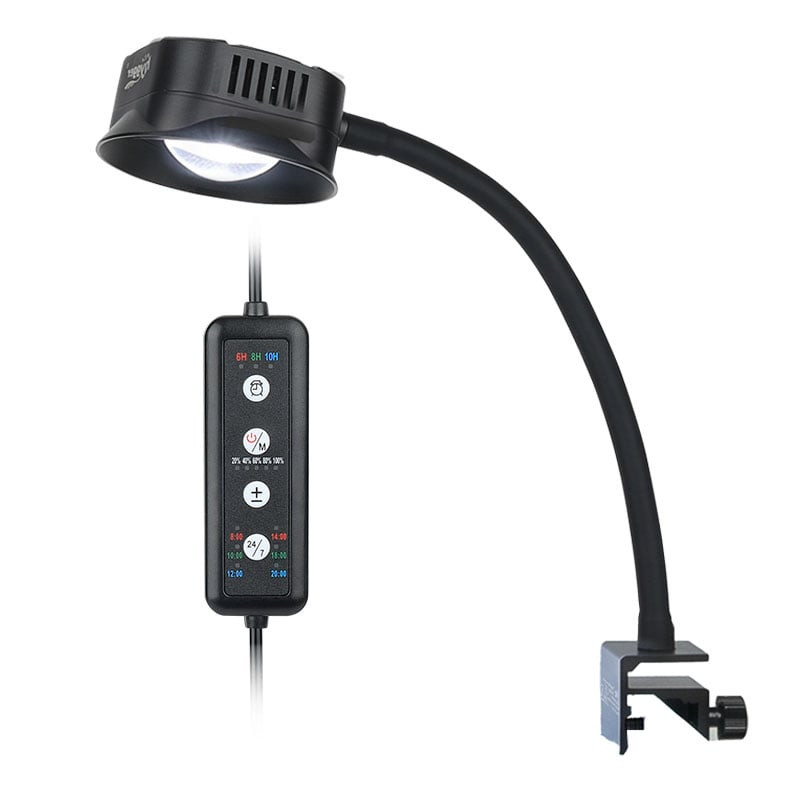
The Mini Pro Aquarium Plant Light, listed at $48.99. It is a 30-watt clip-on light on a flexible gooseneck that the maker says fits glass from 0.2 to 1.0 inch thick. The controller offers three modes (planted, fish and moonlight), five brightness levels, a 6, 8 or 10 hour timer and a CRI rating of 92 or higher. Because it is a newer model, it has only one review on the maker’s site so far. Check current price.
For a standard rectangular tank
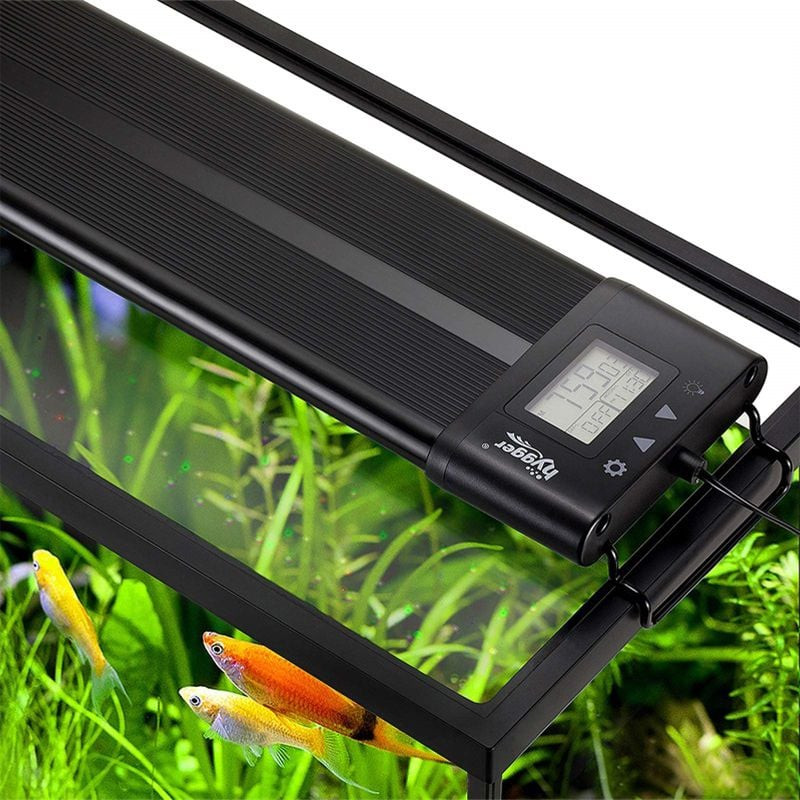
The Planted Aquarium Lighting bar light (model HG957) is sold by tank length. Prices run from $32.99 for the 20-watt version (12 to 18 inches) to $84.99 for the 72-watt version (48 to 55 inches). It runs a programmable 24-hour cycle with 15-minute sunrise and sunset transitions, and offers seven colors and ten brightness levels. The light also remembers its settings after a power cut, and the listing describes it as IP68 water-resistant with no fan. It is the most reviewed light in the range, with 96 reviews averaging about 4.9 on the maker’s site on October 14, 2026. The listing quotes PAR figures from 201 to 420 but does not say at what depth they were measured, so I would not compare them with other brands. Check the price for your tank length.
For a rimless square tank with demanding plants
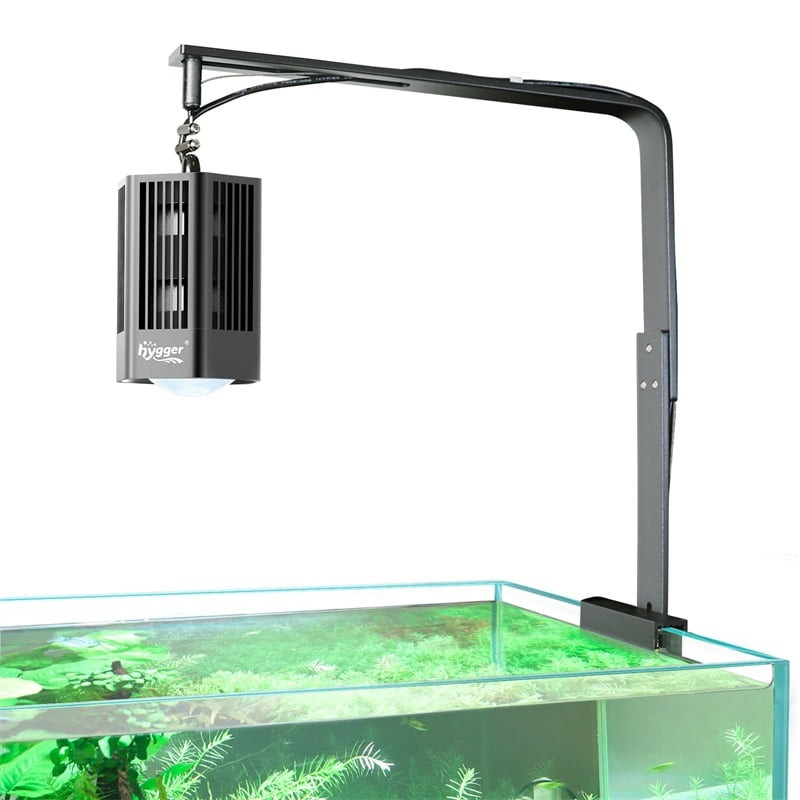
The Max Pro Plant Light, $115.99 for the 60-watt version or $135.99 for the 100-watt version. It is a COB spotlight on an adjustable arm for rimless tanks with glass up to 0.7 inch thick. The maker gives a useful depth of about 15 to 18 inches for the 60-watt model and 20 to 24 inches for the 100-watt model. It suggests the stronger version for carpeting plants such as Monte Carlo and dwarf hairgrass. This one has a fan, described as silent, and no built-in timer: the maker recommends a plug-in timer or smart plug. It had 20 reviews averaging 4.9 on October 14, 2026. Check current price.
Mini Pro Aquarium Plant LightPlanted Aquarium Lighting (HG957)Max Pro Plant LightImages: hygger, from its product pages.
These lights come with clear size charts by tank length and depth figures for the spotlight. The bar and clip-on models have built-in timers with sunrise and sunset. On the other side, the warranty excludes the light source itself, and the bar light’s PAR figures come without a measurement depth. The newest models have few reviews, and a change-of-mind return travels back at your expense. The price depends on tank length, so check it for your exact length.
If this is not the right fit
If your plants are all low-light species, the light that came with your tank may be enough. Try adjusting the hours before buying anything.
If you want measured PAR charts at several depths, specialist planted-tank brands publish them, usually at a higher price.
For a reef or saltwater tank, look for lights designed for corals; their spectrum and intensity needs are different.
If algae is already a problem, shorten the photoperiod and stabilize maintenance first. A new light will not fix it on its own.
Planted aquarium light checklist
My plant list tells me whether I need low, medium or high light.
The light is sized for my tank’s length, and strong enough for its depth.
Its mounting suits my tank: rimmed or rimless, and my glass thickness is within the stated limit.
A timer is built in, or I have one ready.
Any PAR figure I am relying on comes with a stated depth.
For a high-light setup, the plan for CO2 and fertilizer is in place.
I have read the shipping, damage, return and warranty terms.
Frequently asked questions
Do I need a special light for aquarium plants?
For low-light plants, most modern full-spectrum LED aquarium lights are enough. A dedicated plant light matters when you want medium or high-light plants, a deep tank, or dense growth.
How many hours a day should a planted tank light be on?
About 6 to 8 hours of full light is a common target. Start at the lower end in a new tank and adjust slowly, one change at a time.
Is a stronger light always better for plants?
No. Plants can only use extra light if they also have enough carbon and nutrients. Without them, more light mostly grows algae.
What Kelvin is best for a planted tank?
Around 6,500 to 7,000 K is a common choice because it looks natural and supports growth. Many lights also let you add red or blue to change the look.
Can I use a regular household LED?
It can grow low-light plants, but aquarium lights are built to survive humidity, fit across the tank and spread light evenly. A household bulb is a stopgap rather than a long-term answer.
Light it gently
The calmest planted tanks are rarely the brightest. They run a light that suits their plants, on a steady schedule, and they change one thing at a time. Choose the plants first, buy the light that matches them, and give the tank a few weeks before deciding it needs more.
Photos: Michael Hystead and Josephina Kolpachnikof on Unsplash; they show planted tanks in general, not the products in this article. Product images: hygger. Product details and policies: hygger’s product pages, shipping policy, terms of use and warranty page, checked on October 8, 2026. I rechecked prices, stock and review counts on October 14, 2026. Light figures are widely used guidelines for freshwater planted tanks, not rules; when in doubt, ask a local fish store or an experienced keeper.
M. Caelestis is the pen name of the editor of Time’s Ripple. Aquarium articles here are researched from manufacturers’ product pages and policies, widely used fish-care guidelines and public reviews, and checked against those sources on the date given in each article. Products are not hands-on tested unless an article says so.