Disclosure: this article contains affiliate links. If you buy through them, Time’s Ripple may earn a commission at no extra cost to you. Product details come from the maker’s published product pages and policies, checked in October 2026. How this site handles affiliate links.
Most planted tanks reach a point where the plants stop doing much. They are not dying, exactly. They are holding on: a few new leaves a month, a little algae on the older ones, stems that grow long and thin toward the light. The usual advice at that point is “add CO2,” and the usual response is to buy an aquarium CO2 system.
Sometimes that is the right move. Often it is not, or not yet. Carbon dioxide speeds plant growth, but it also speeds up everything that goes wrong when light, nutrients and maintenance are out of balance. It is one of those purchases where the honest first question is not “which one?” but “do I need it at all?”
This guide covers that question first, then the three ways to add carbon and the parts of an aquarium CO2 system. After that come safe setup for your fish, where to buy and what to check in the fine print. If you are still setting up your first tank, start with the betta tank guide instead, and come back here once the tank has settled. When you are ready to buy, the checklist near the end lists what to have in place first, from a drop checker to a timer.
The short answer
Most low-tech tanks with hardy plants do not need CO2. It pays off when you already run a strong light, dose fertilizer and want carpeting or red plants. For those tanks, a reaction generator suits up to roughly 30 gallons and a pressurized cylinder suits larger ones.
Links in this box are affiliate links. Prices and stock are from hygger’s US store on October 14, 2026 and change often. What is in each box, and the safety points, are in the hygger section below.
Do your plants actually need an aquarium CO2 system?
Plants build themselves out of carbon, and in most aquariums the water holds only a few parts per million of dissolved CO2. Planted-tank keepers commonly aim for something closer to 20 to 30 ppm when they inject it. That gap is why adding CO2 can make such a visible difference to how fast plants grow. But plants only use extra carbon if they also have enough light and nutrients. Without them, the extra carbon mostly feeds algae.
A useful way to decide is to look at the tank you have, not the tank you want:
Low-tech tank
High-tech tank
Light
Low to moderate
Moderate to strong
CO2
None, or liquid carbon
Injected daily
Typical plants
Anubias, java fern, cryptocorynes, mosses, many stem plants grown slowly
Carpeting plants, red stem plants, dense fast growth
Maintenance
Light trimming, a water change every week or two
Frequent trimming, regular fertilizing, weekly water changes
Forgiveness
High
Low: small imbalances show up as algae within days
You probably do not need CO2 yet if your plants are hardy, slow-growing species, your light is modest, or you are not ready to trim and fertilize every week. Plenty of the most beautiful aquariums are low-tech: quiet, slow and stable.
CO2 is worth considering if you want carpeting or red plants and you already have a strong light and dose fertilizer. The other sign is plants showing classic carbon-limited symptoms even though light and nutrients are in place: slow growth, pale new leaves and algae on old ones.
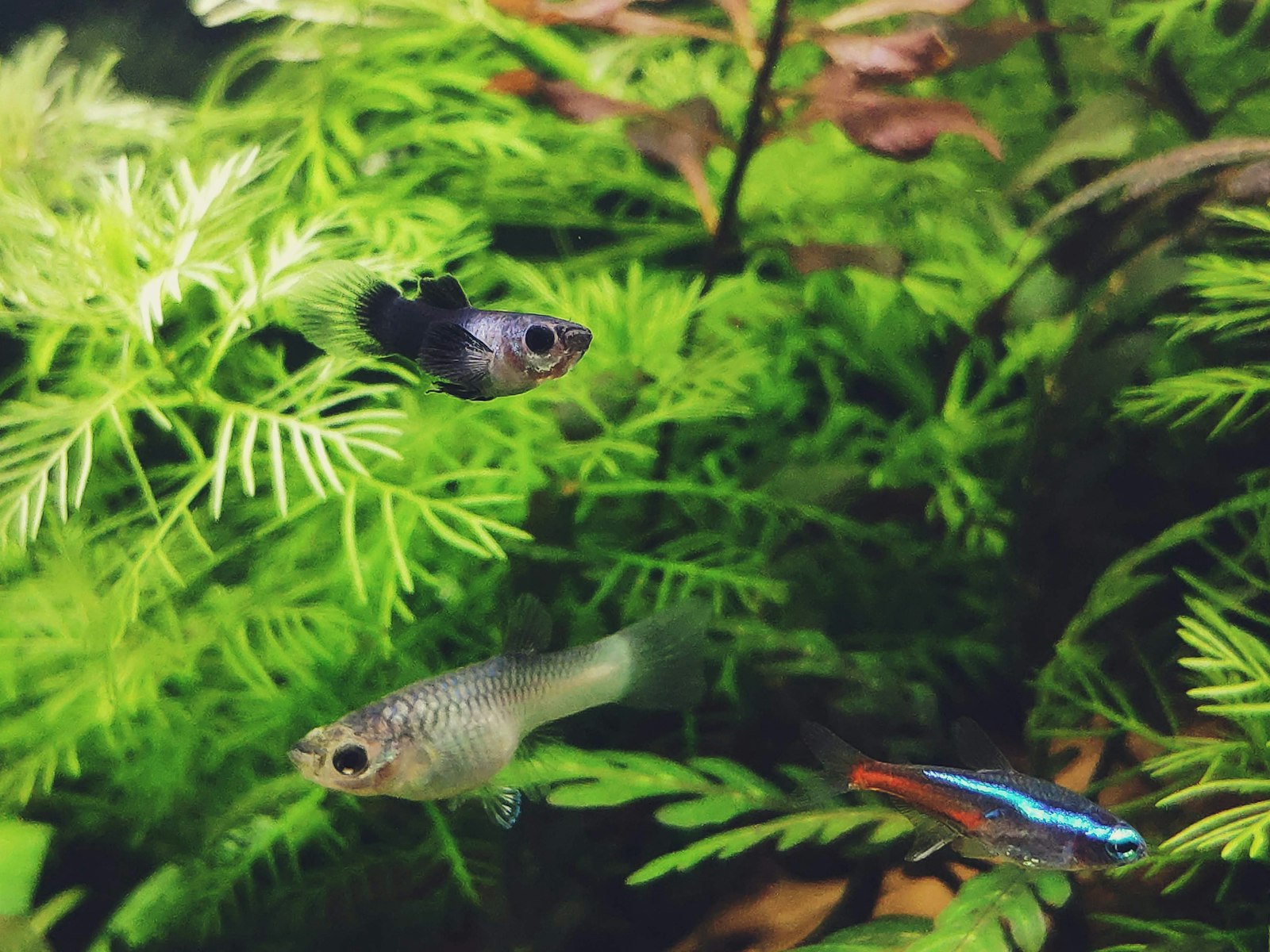
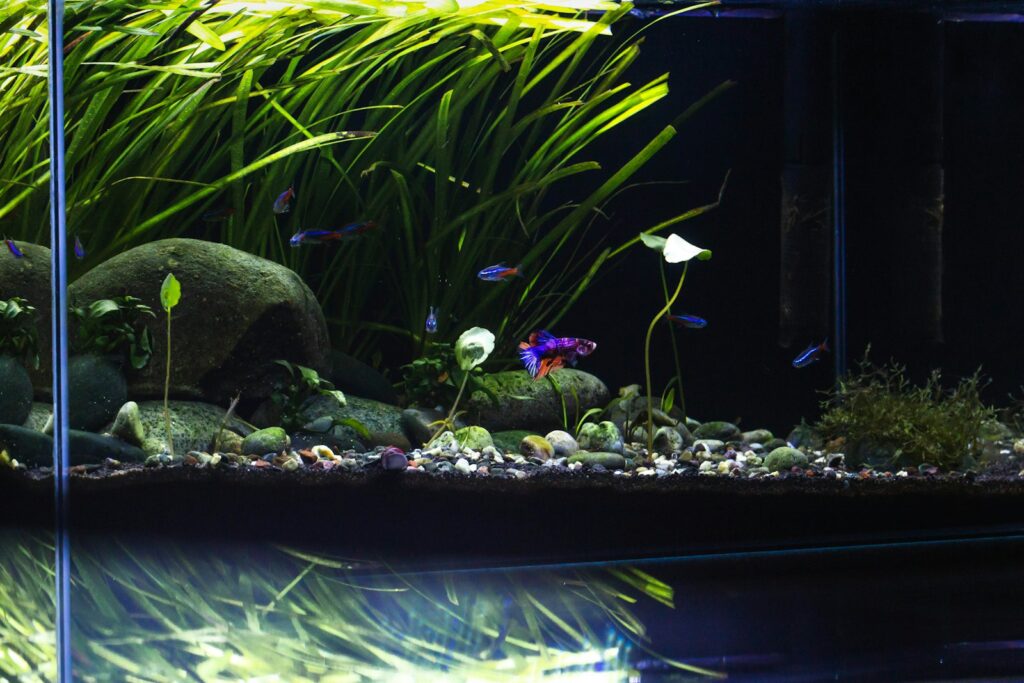
Strong light needs carbon and nutrients to match. Photo by Christian Ang on Unsplash
1. Light, carbon and nutrients work as a set
Think of plant growth as a three-legged stool: light, carbon and nutrients. Growth is limited by whichever leg is shortest. Raise the light without adding carbon and the plants cannot keep up, which is an invitation for algae. Add carbon without nutrients and the plants stall at the next shortage.
The practical rule follows from that: change one thing at a time, in this order. Get the light right, then fertilize to match, and only then add CO2 if growth is still limited. When you do add CO2, start low and raise it slowly over a couple of weeks, adjusting fertilizer as the plants speed up.
2. Three ways to add carbon
Method
How it works
Good for
Trade-offs
Liquid carbon
A daily liquid supplement that plants can use as a carbon source
Small low-tech tanks; a gentle boost with no hardware
Much weaker than injected CO2; some plants and invertebrates are sensitive to it; follow the label dose exactly
CO2 generator (chemical reaction)
Citric acid, baking soda and water react in a sealed bottle and release CO2 through a regulator and valve
Small to medium tanks; no gas cylinder to refill
You refill the reaction by hand; output depends on the reaction, so watch it more closely than a cylinder
Pressurized cylinder
A refillable CO2 cylinder with a regulator, solenoid and needle valve
Medium to large tanks; the most stable, adjustable supply
Highest upfront cost; you need a nearby place to refill or swap cylinders
There is also the classic yeast-and-sugar bottle. It is cheap and a good experiment. Its output rises and falls as the yeast works, though, so it is hard to keep steady, and most keepers move on from it quickly.
3. The parts of an aquarium CO2 system, and what each one does
Whether the gas comes from a reaction bottle or a cylinder, the rest of the system is much the same. Knowing the parts makes product listings far easier to compare.
Part
What it does
Why it matters
Regulator
Reduces the bottle’s high pressure to a low, steady working pressure
A stable output pressure means a stable bubble rate
Needle valve
Fine-tunes the flow
The difference between “a little more” and “far too much” is a very small turn
Solenoid or motorized valve
Switches the CO2 on and off, usually from a timer
Lets CO2 run only when the lights are on
Bubble counter
Shows the gas flow as bubbles you can count
Your everyday way to see that the system is working
Check valve
Lets gas out but stops water flowing back up the tube
Protects the regulator and valve from tank water
Diffuser
Breaks the gas into very fine bubbles that dissolve in the water
Finer bubbles waste less CO2
Drop checker
A small glass bulb of indicator fluid that changes color with CO2 level
Tells you whether the level is too low, about right or too high
4. Generator or cylinder? Sizing an aquarium CO2 system to the tank
For a tank of a few gallons up to roughly 30 gallons, a reaction generator is a reasonable starting point, and it avoids finding somewhere to refill a cylinder. For larger tanks, or a tank with strong light and dense planting, a pressurized cylinder gives steadier output with less attention.
Two practical points if you go the cylinder route in the United States. First, check that the regulator fits your cylinder valve before you buy, and ask the seller if the listing does not say. Second, find out where you can refill or swap a cylinder locally. Homebrew, welding and fire-extinguisher suppliers often handle CO2.
5. Setting it up without harming the fish
CO2 is safe for fish at the levels plants use, and harmful above them. Fish need dissolved oxygen, and too much CO2 makes it harder for them to breathe. Almost every CO2 accident comes from turning it up too fast or leaving it on overnight. A careful start looks like this:
Start low. Begin at a slow bubble rate, often around one bubble per second for a small to medium tank, and raise it in small steps every few days.
Put it on a timer. Have the CO2 switch on about an hour before the lights and off about an hour before they go out. Plants do not use CO2 in the dark.
Use a drop checker. With the standard reference solution, blue means too little, green means about right, and yellow means too much. Place it away from the diffuser, and remember it lags behind the water by an hour or two.
Watch the fish, especially in the first week and in the hours after the CO2 switches on. Fish gasping at the surface means too much CO2: turn it down and increase surface movement at once.
Keep some surface movement. A gently rippling surface lets oxygen in. A perfectly still surface makes CO2 problems more likely.
Change one thing at a time and give each change several days before the next.
6. Safety with generators and cylinders
Both kinds of system hold gas under pressure. Treat them with the same care you would give any pressurized container:
Follow the maker’s quantities exactly. Overfilling a reaction bottle raises the pressure.
Keep the bottle or cylinder upright, and never shake, tilt or invert a reaction bottle while it is running.
Use only the chemicals the maker specifies. Never substitute stronger acids or bases.
Release the pressure fully before opening a reaction bottle to refill it.
Keep electrical valves and timers dry and above the waterline.
Check fittings for leaks with soapy water when you set up and after every refill.
7. Where to buy
Route
Best for
Trade-offs
A local fish store with a planted-tank focus
Advice, help with setup, sometimes cylinder refills
Selection and prices vary a lot
A general online marketplace
Choice and price comparison
Many near-identical kits with unclear specifications; check what is really in the box
An equipment maker’s own store
Full package lists, matched parts, written policies
Only that maker’s range; check shipping areas and return terms
Building your own from separate parts
Choosing exactly the regulator, valve and diffuser you want
More research, and more fittings that can leak
8. How to judge a CO2 kit from a product page
The full package list. Does it include the regulator, solenoid or motorized valve, needle valve, bubble counter, check valve, diffuser and tubing? Is a timer included, or do you need your own?
What is not included. Generators need citric acid and baking soda; regulators need a cylinder. Both are often sold separately.
Bottle material and safety features. Stainless steel is sturdier than plastic, and a pressure relief valve is a sensible safeguard.
Stated tank size or output, so you are not buying a system far too small or too large for your tank.
Recent reviews that mention leaks, valves failing or customer service.
9. Read the policies before you order
The same questions apply as with any aquarium equipment. Ask what shipping costs, how long it takes and what happens if something arrives damaged. Then check who pays for a return and what the warranty covers and excludes. For a CO2 kit, also check whether a used or opened system can be returned at all, since many sellers only accept unused items in original packaging. My betta tank guide goes through these questions in more detail.
hygger sells a small CO2 range through its own US store, and the kits below come from it. Each product page has a full package list, which is why they are the examples here. With CO2, the extras are easy to miss: reaction chemicals, a timer or a cylinder. Use the same test on any other brand and price the complete setup, extras included.
Shipping, returns and reviews
hygger ships free to most of the United States (not Alaska, Hawaii, US territories, P.O. boxes or APO/FPO addresses) and, according to its return policy, replaces anything damaged in transit. Change-of-mind returns are accepted within 30 days for unused items in their original packaging, with the return shipping on you. Its CO2 products themselves have only a handful of reviews each on its own site, so treat those ratings lightly. The full terms are summarized in my betta tank setup guide.
hygger’s aquarium CO2 system options
The CO2 options in its range, from simplest to most capable:
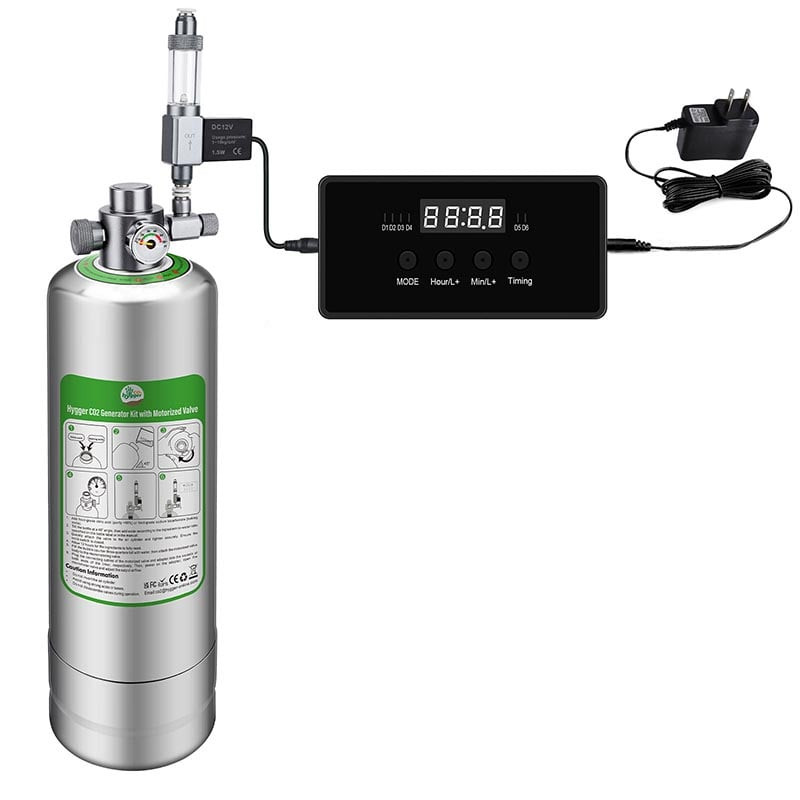
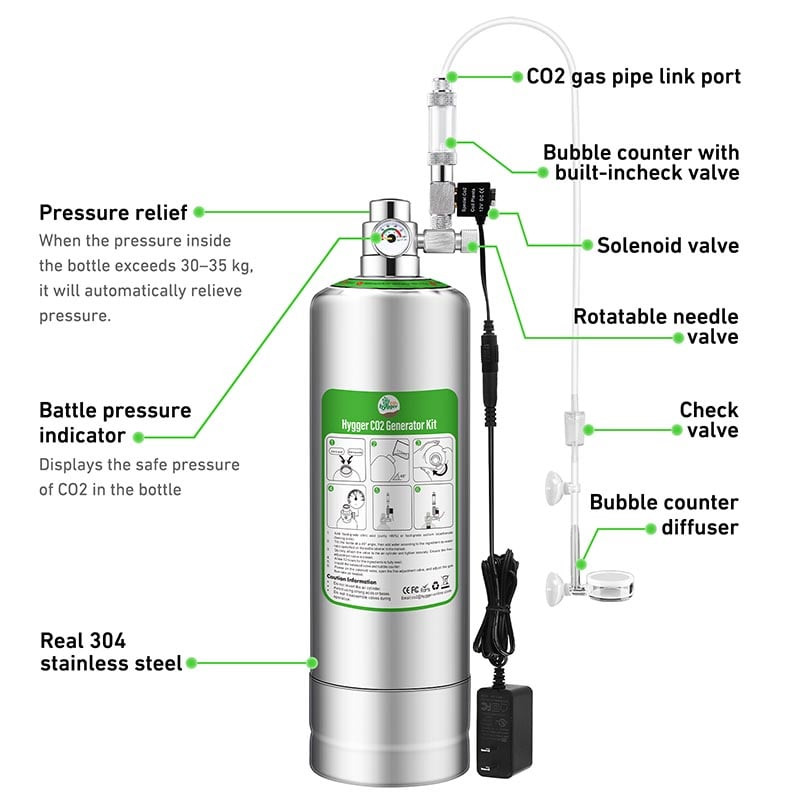
A generator with its own timer: the CO2 Generator Kit with Motorized Valve (model HC031), listed at $99.99 for the 2-liter size and $179.99 for the 5-liter size. It comes with a stainless steel bottle, a motorized valve with bubble counter, a timer, a diffuser, tubing and a check valve. The company says a relief valve opens if pressure exceeds 30 to 40 bar. The page notes that the motorized valve is not waterproof and may click softly when it switches. Citric acid and baking soda are not included; for the 2-liter bottle the maker specifies 200 g of each with 300 ml of water. Check current price.
A generator for an existing timer: the CO2 Generator Kit (model HC018), listed at $89.99 for the 2-liter size and $169.99 for the 5-liter size. It includes a stainless steel bottle and regulator, a 12-volt solenoid valve, a needle valve and a bubble counter with a built-in check valve. The solenoid is described as timer-compatible, but a timer is not on the package list, so plan to use a plug-in timer. The maker suggests the 2-liter bottle for smaller tanks and the 5-liter for larger or high-light tanks. Check current price.
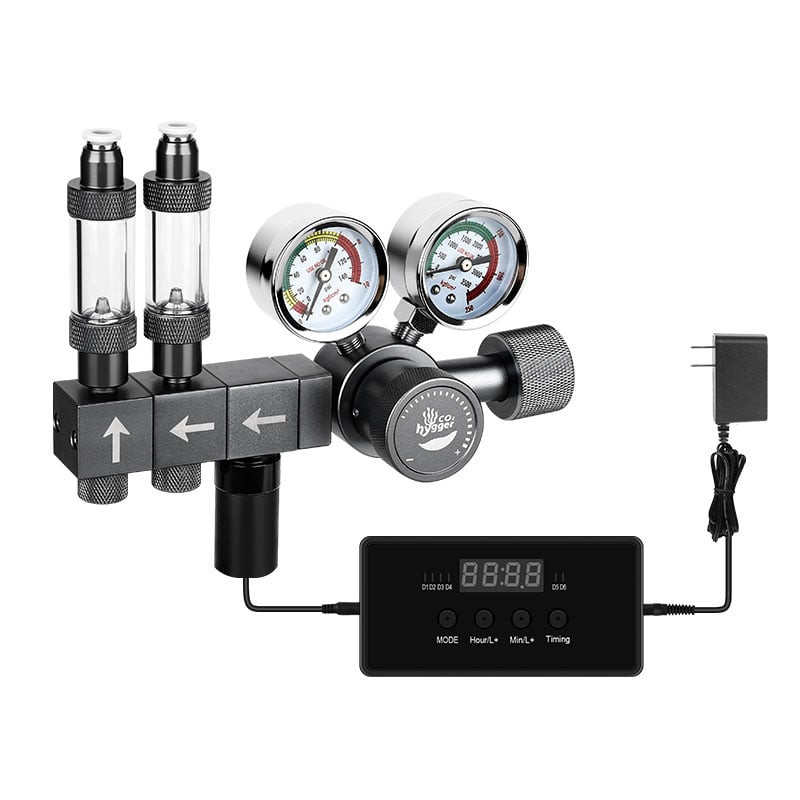
For a pressurized cylinder: the CO2 Regulator with Motor Valve (model HC039), listed at $139.99. It is a dual-stage regulator with two gauges, a needle valve, a motorized valve with timer and two bubble counters, expandable to as many as eight tanks. The cylinder is not included, so confirm the fitting matches your cylinder before ordering. Check current price.
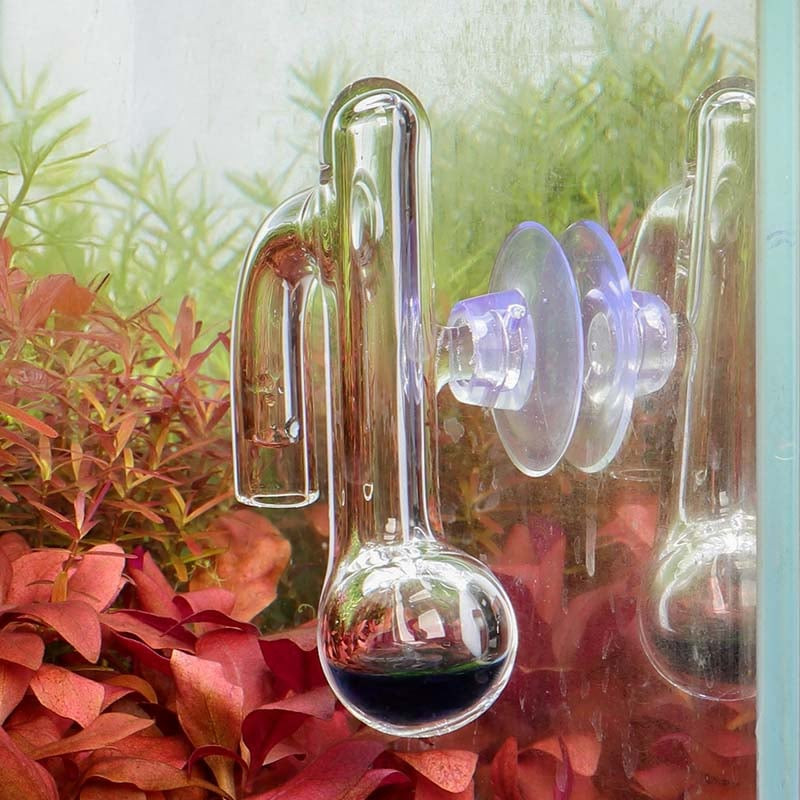
To see what the CO2 is doing: the Nano CO2 Drop Checker Kit, listed at $15.99, a small glass drop checker with indicator solution and a suction-cup mount. Whatever system you choose, this is the part not to skip. Check current price.
CO2 Generator Kit with Motorized ValveCO2 Generator KitRegulator with Motor Valve (HC039)Nano CO2 Drop CheckerImages: hygger, from its product pages.
The range does well on complete package lists, stainless steel bottles with pressure relief, and a timer included on the motorized versions. The costs that sit outside the sticker price are the reaction chemicals and any cylinder, so add them before you compare kits. The reviews are few, and sending a kit back because you changed your mind means paying the shipping yourself.
If this is not the right fit
If your tank is low-tech and you are happy with it, keep it that way. A liquid carbon supplement or simply more patience may be all it needs.
If your tank is large or heavily planted, a pressurized cylinder with a good regulator is usually the better long-term choice than a reaction bottle.
If you want help in person, a local store with planted tanks on display can often set up and tune a system with you, and may refill cylinders.
If algae is your main problem, fix light duration and maintenance first. CO2 rarely solves algae on its own and can make it worse.
Aquarium CO2 system checklist
My plants are limited by carbon, not by light, nutrients or neglect.
I know whether a generator or a cylinder suits my tank size and my patience for refills.
Everything I need to buy separately is on my list: chemicals, cylinder, timer.
A drop checker is ready, and the plan is to start low and raise CO2 slowly.
The CO2 will run on a timer, only while the lights are on.
I have enough surface movement, and I will watch the fish closely for the first week.
I have read the shipping, damage, return and warranty terms.
Frequently asked questions
Is CO2 safe for fish?
At the levels planted tanks aim for, yes, provided the surface is moving and the CO2 runs only with the lights. Too much CO2 makes it hard for fish to breathe; gasping at the surface is the warning sign.
Do I need CO2 for a betta tank?
Usually not. A small betta tank with hardy plants such as anubias, java fern or cryptocorynes does well without it, and stable water matters far more to the fish.
Should CO2 run at night?
No. Plants use CO2 only while they have light. Switch it on about an hour before the lights and off about an hour before they go out, ideally with a solenoid or motorized valve on a timer.
How long does a citric acid generator last between refills?
It depends on bottle size, tank size and bubble rate, so makers rarely promise a number. Watch the bubble counter: when the rate drops, it is time to release the pressure and refill.
What color should the drop checker be?
With the common reference solution, green means about right, blue means too little and yellow means too much. Read it at the end of the lit period, since it lags behind the water.
Add the gas last
Good planted tanks are rarely built by buying the most equipment. They are built by changing one thing, waiting, and watching. Get the light right, feed the plants, keep the water clean, and only then, if the plants are clearly asking for it, add carbon. A tank grown slowly tends to stay healthy for a long time.
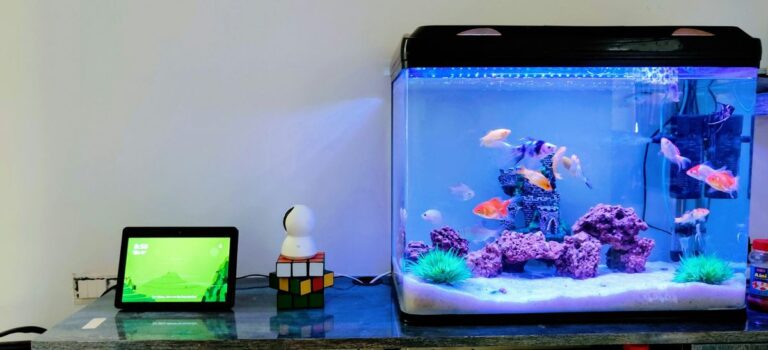
Photos: George Wong and Christian Ang on Unsplash; they show planted tanks in general, not the products in this article. Product images: hygger. Product details and policies: hygger’s product pages, shipping policy, terms of use and warranty page, checked on October 8, 2026, with prices and stock rechecked on October 14, 2026. CO2 figures are widely used guidelines for freshwater planted tanks, not rules; when in doubt, ask a local fish store or an experienced keeper.
M. Caelestis is the pen name of the editor of Time’s Ripple. Aquarium articles here are researched from manufacturers’ product pages and policies, widely used fish-care guidelines and public reviews, and checked against those sources on the date given in each article. Products are not hands-on tested unless an article says so.