Disclosure: this article contains affiliate links. If you buy through them, Time’s Ripple may earn a commission at no extra cost to you. Product details come from the maker’s published product pages and policies, checked in October 2026. How this site handles affiliate links.
Most bettas sold in the United States go home in a plastic cup. Many of them stay in something not much bigger: a vase, a bowl, a one-gallon “betta tank” sold beside the register. It looks like the frugal choice. It is usually the expensive one. A fish in a small, cold, unfiltered tank tends to get sick, and the money and the fish are both gone within a year. A proper betta fish tank setup costs more on the first day and far less over the life of the fish.
This guide walks through a complete betta fish tank setup for the fish most beginners start with. It covers size, what a kit includes and what it leaves out, and the filter, heater and light. It also covers where the tank should stand, the weeks of preparation before the fish arrives, where to buy and what to check in the fine print. If you are buying today, the checklist near the end lists the seven things to have in place before the fish comes home.
The short version: a starter list for one betta
A betta needs at least 5 gallons of actual water, a heater, a gentle filter, a thermometer and a test kit. The tank should run for several weeks before the fish arrives. Here is one way to put that list together from a single maker.
Removes chlorine, stops jumping, gives the fish cover
Any pet store
Varies
At those prices the four hygger items came to about $175 to $185, with free shipping to the contiguous United States.
Links in this box are affiliate links. Prices and stock are from hygger’s US store on October 14, 2026 and change often. What each item does, and what to check before you order, is in the hygger section below.
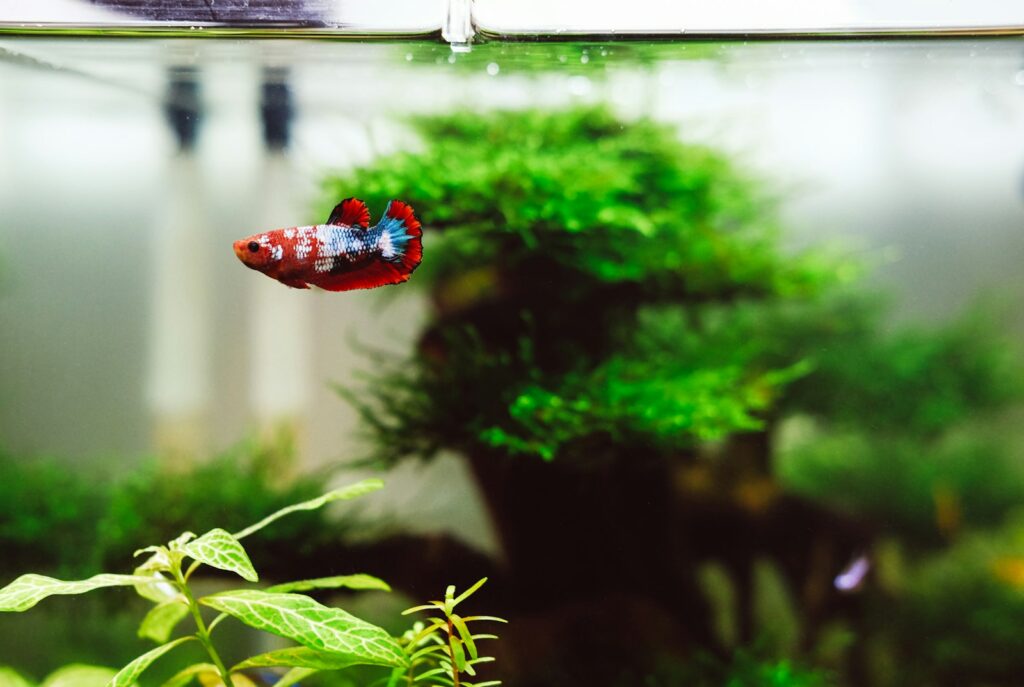
Live plants give a betta places to rest near the surface and to hide. Photo by Huy Phan on Unsplash
Betta fish tank setup: what a betta actually needs
Bettas are often sold as fish that are happy in a puddle, because in the wild they live in shallow rice paddies and slow streams in Southeast Asia. Shallow is not the same as small, though, and those waters are warm, planted and stable. The care guidelines most experienced keepers and aquarium shops now agree on look like this:
At least 5 gallons of actual water. More water means temperature and water quality change more slowly, which gives you more room for mistakes.
A heater. Bettas are tropical fish. Most keepers aim for about 76 to 82°F, and a typical home at night is colder than that.
A filter with gentle flow. Long-finned bettas are weak swimmers, and a strong current wears them out.
A cover. Bettas can jump, and they breathe air from the surface, so a lid with a small gap works better than an open top.
A tank that is ready before the fish is. More on that below, because it is the step most beginners skip.
Is a betta the right first fish for you?
Before getting into equipment, it is worth being honest about the commitment.
A betta suits you if you want one fish with a lot of personality rather than a busy community tank. You will also want a stable spot indoors with an outlet nearby and half an hour a week for a partial water change. Bettas commonly live three to five years with good care.
It may not suit you if you travel often and have no one to look after the tank. It is also a poor fit if you want several kinds of fish together, since male bettas in particular do not share well. The same goes if the only space you have is a windowsill. In that case, a planted tank with no fish, or simply waiting, is the better choice.
1. How big should a betta tank be? Count the water, not the label
Five gallons is the common minimum, and many keepers suggest something closer to 10 if you have the space. But the number on the box is not always the amount of water you get. Built-in backgrounds, filter compartments and the gap below the rim all take up volume.
The maker of the 8-gallon kit featured later in this guide says so plainly on its own product page. The tank has a total volume of 8 gallons but holds about 6 gallons of water, because of its attached 3D background. That is still above the 5-gallon minimum, and it is exactly the kind of detail worth looking for on any listing.
Water is also heavy, about 8.3 pounds per gallon, before you add glass, gravel and decorations. The same maker puts that 8-gallon kit at roughly 68 pounds when filled. Here is what that means for the furniture underneath:
Water in the tank (gallons)
Water alone
Rough total with glass and gravel
5
about 42 lb
about 55 to 65 lb
8
about 67 lb
about 80 to 95 lb
10
about 83 lb
about 100 to 115 lb
That is why the 8-gallon kit above, which holds about 6 gallons, comes in nearer the first row than the second. A bookshelf or a light desk that wobbles when you lean on it is not a fish tank stand. Choose a surface that is solid, level and rated for the weight, and never place a tank on furniture that flexes.
2. What a betta fish tank kit includes, and what it leaves out
A tank kit is usually the easiest way to start, because the filter and light are chosen to fit the tank. But “all-in-one” rarely means everything you need. Read the package list, not the marketing copy above it. These are the items most often missing:
Item
Why you need it
Usually in a kit?
Tank, filter, light
The basic system
Yes, check the package list
Heater
Bettas need stable tropical temperatures
Often not
Water conditioner
Removes chlorine and chloramine from tap water
Rarely
Test kit
Tells you when the tank is safe for a fish
Rarely
Thermometer
Confirms what the heater is doing
Sometimes built into the heater
Lid or cover
Stops jumping and slows evaporation
Varies; check the photos and list
Substrate and plants
Hiding places, resting spots and help with water quality
Rarely
Budget for the missing pieces before you decide which kit is the bargain. A cheaper kit that leaves out the heater is not cheaper.
3. Filter and flow: gentle beats powerful
A filter does two jobs. It moves water through a sponge or cartridge that traps debris, and, more importantly, it gives a home to the beneficial bacteria that break down fish waste. That second job is why you should never replace all the filter media at once, and why you rinse it in old tank water rather than under the tap. If you want gentle flow from day one, a sponge filter on a small air pump is a common choice for bettas, and my sponge filter guide explains how to size and clean one.
For a betta, the risk is too much flow, not too little. Signs that the current is too strong include a fish that hides in one corner, gets pushed around the tank, or rests on the bottom near the filter. Simple fixes:
Turn the flow down if the filter has an adjustment.
Wrap the intake or outlet with a piece of aquarium sponge or filter floss to soften the current.
Place a plant or decoration in the path of the outflow so it breaks up the stream.
Look for a manufacturer that is upfront about this. The maker of the kit featured below notes on its product page that the filter may be too strong for fish smaller than two inches. It suggests wrapping the filter with sponge or reducing the power. That kind of honesty in a listing is a good sign.
4. Choose the heater by gallons, then check it with a thermometer
A common rule of thumb is about 3 to 5 watts per gallon, so a 25 to 50 watt heater for a 5 to 10 gallon tank. More important than the wattage:
Adjustable is better than preset. Some small heaters are fixed at one temperature; an adjustable dial lets you correct it.
Look for automatic shut-off and, ideally, overheat protection.
Place it where the water moves, near the filter outflow, so warm water spreads through the tank instead of pooling.
Keep it fully submerged if the instructions say so, and unplug it before every water change.
Trust a thermometer, not the dial. Check the temperature in the morning and evening for the first few days.
For more on sizing, the safety features worth paying for and how to tell whether a heater is actually working, see the betta fish heater guide.
5. Light and placement
Fish do not need a light on all day, and a light left on too long mostly grows algae. Around 6 to 8 hours a day is a common target; the maker of the kit below recommends a maximum of 8. A light with a built-in timer keeps those hours the same every day without you having to remember the switch. If you plan to grow live plants, how to choose a planted aquarium light explains what the numbers on the box mean.
Where the tank stands matters as much as what is in it:
Away from windows. Direct sun heats the water and feeds algae.
Away from drafts, heaters, radiators and air-conditioning vents, which make the temperature swing.
Near an outlet, with a drip loop: let each power cord dip below the outlet before it rises to the plug. Water running down the cord then drips onto the floor rather than into the socket.
Somewhere you will see it. A tank on a desk or in the living room gets noticed when something is wrong. A tank in a spare room gets forgotten.
6. The step most beginners skip: cycle the tank first
A small planted tank. Stable water comes from patience as much as from equipment. Photo by Huy Phan on Unsplash
Fish produce ammonia, which is toxic even in small amounts. In an established tank, bacteria living in the filter and on surfaces turn ammonia into nitrite, and then nitrite into much less harmful nitrate, which you remove with water changes. This is called the nitrogen cycle, and a brand-new tank does not have it yet.
“Cycling” means growing those bacteria before the fish arrives. The usual approach is a fishless cycle. Set up the tank, run the filter and heater, add a small source of ammonia (fish food or bottled ammonia), and test the water every few days. It commonly takes several weeks, often four to six. The tank is ready when ammonia and nitrite both read zero a day after you add ammonia, and nitrate is showing.
Bottled bacteria products can speed things up, and some keepers cycle with the fish already in the tank, using frequent small water changes. Both work, but both need a test kit, because you are guessing without one. If you take only one thing from this guide, it is this: set up the tank, then buy the fish.
7. Where to buy: four routes
Route
Best for
Trade-offs
A local independent fish store
Advice in person, healthy fish, help with water testing
Equipment prices are often higher; selection varies a lot by store
A large pet-store chain
Convenience, carrying a tank home the same day, easy returns
Staff knowledge is uneven, and the smallest “betta tanks” on the shelf are often too small
A general online marketplace
Wide choice, price comparison, many reviews
Listings and sellers vary; glass can arrive broken, and returns of heavy items can be awkward
An equipment maker’s own store
Full specifications, matched parts, clear written policies
Only that maker’s products; check shipping areas and how broken glass is handled
One sensible split: buy the equipment wherever the specifications and policies are clearest. Buy the fish from a local store, where you can see it swim before you take it home.
8. How to judge a tank from a product page
Actual water volume, not only the nominal gallons.
A package list that says exactly what is in the box.
Filter specifications: the flow rate (often given in gallons per hour) and the tank size it is designed for. A flow rate far above about five to ten times the tank volume per hour is likely too strong for a betta without adjustment.
Light details: whether it has a timer, and whether it is meant for plants or only for viewing.
Packaging: how the glass is protected in transit.
Customer photos and recent reviews, especially ones that mention noise, leaks or parts failing after a few months.
9. Read the policies before you order glass
A glass tank is heavy, fragile and awkward to return, so the policies matter more than they would for most purchases. Look for clear answers to these:
Shipping: is it free, how long does it take, and does the seller ship to your address? Some exclude certain states, P.O. boxes and military addresses.
Broken on arrival: what happens if the glass is cracked when it arrives? Open the box and fill the tank with a little water to check for leaks within the first day or two, and keep the packaging until you are sure.
Returns: how many days, in what condition, and who pays to send a heavy box back?
Warranty: what does it cover, and what does it exclude? Many aquarium warranties exclude glass breakage and wear parts such as lights, impellers and filter media, which are the parts most likely to fail.
The kit and heater below are from hygger. I picked its 8-gallon kit because the product page gives the tank’s real water volume next to the label size. That is the first check in this guide. Other makers’ kits can be judged with the same questions. hygger makes aquarium equipment, including tanks, lights, filters and heaters, and sells it through its own US store as well as through large retailers. The company had a TrustScore of about 4.6 out of 5 from more than 400 reviews on Trustpilot when I checked in early October 2026. The positive reviews mostly praise customer service and replacements. The negative ones mention some electrical parts failing after a few months and setup instructions that could be clearer. Here is what its published policies said in October 2026:
Shipping, returns and warranty
Shipping: free shipping on all orders placed on its site. Orders placed before 6:00 AM Pacific Time are expected to ship within 1–3 business days, and normal delivery takes 5–7 days, sometimes a day or two longer in remote areas.
Where it ships: the United States only. It does not currently ship to Alaska, Hawaii, Puerto Rico, Guam, the US Virgin Islands, P.O. boxes or APO/FPO addresses.
Damage in transit: the company says a product damaged during shipping is replaced automatically. Its 8-gallon kit page also describes triple-layer packaging for the glass.
Returns: 30 days from purchase for products that are unused, undamaged and in their original packaging (live aquatic animals excluded). For returns made for other reasons, getting the item back is the buyer’s responsibility, and shipping charges are not refunded.
Warranty: the product page lists 2 years for electrical and 3 years for non-electrical items. The warranty page excludes wear parts, including light sources and filter media, as well as glass breakage.
Orders: you can modify or cancel an order from your account before it ships, and tracking is emailed when it does.
Rewards: a free points program gives 1 point for each dollar spent, and 10 points are worth $1 off a later order, according to its Rewards page.
Strengths and trade-offs
For a first tank, the useful parts are free shipping and automatic replacement for anything broken in transit. The specifications are candid enough to give the real water volume. The catches: returns for a change of mind cost you the shipping, and the warranty does not cover the glass or the light. Delivery takes about one to two weeks in total.
A betta fish tank setup from its range
A small setup for a single betta, built from its current range:
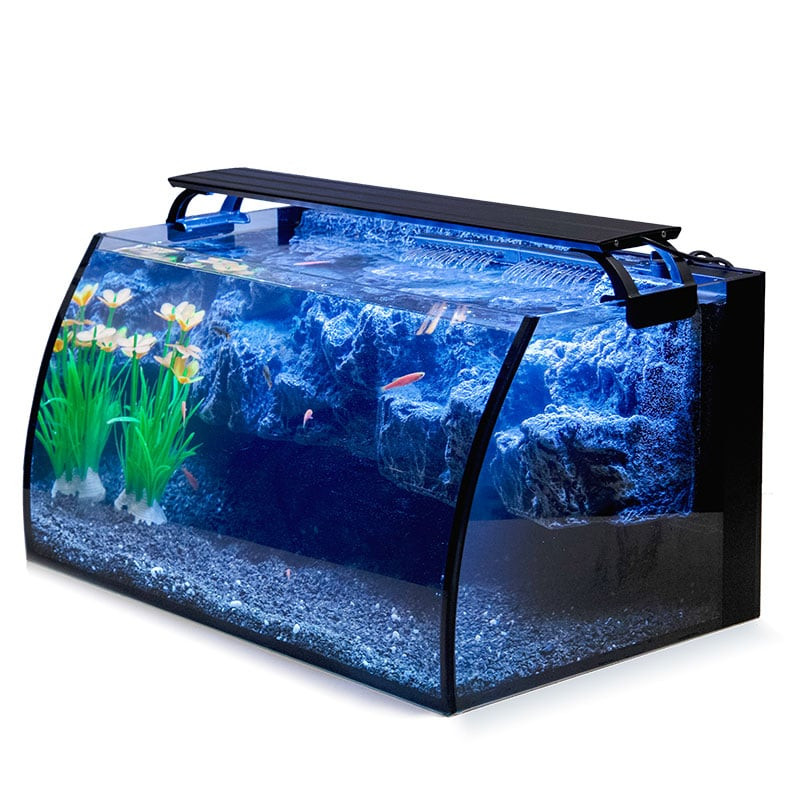
The tank: the 8 Gallon Fish Tank Kit (model HG906), listed at $135 when I checked. It comes with a curved-front glass tank with a 3D rock background and a 7-watt internal filter rated for 2 to 8 gallons. The LED light has three color modes, five brightness levels and a 3, 6 or 12 hour timer. It holds about 6 gallons of water. The company says the filter may be too strong for small fish, so plan to soften it with a sponge for a long-finned betta. The package list does not mention a lid or a heater.
The heater: the 5 Gallon Fish Tank Heater, whose 50-watt version is rated for 5 to 15 gallons. It was listed at $19.99 and on sale for $16.39 when I rechecked on October 14, 2026. It is adjustable from 68 to 90°F, has a built-in thermometer, and switches itself off above 90°F.
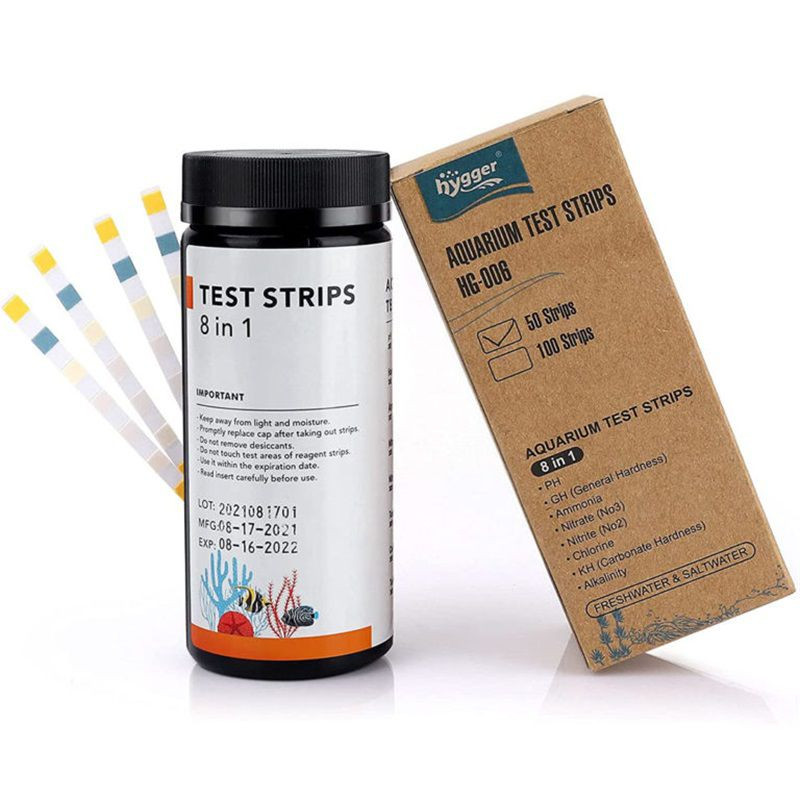
The test kit: the 8-in-1 Aquarium Water Test Kit, dip strips that read eight parameters including ammonia and pH in about 30 seconds. Strips are quick for routine checks; liquid kits are generally considered more precise when you need to be sure.
The thermometer: the External Aquarium Thermometer (model HG073), $13.99 to $15.99. It sticks to the outside of the glass; one version records the minimum and maximum temperature, the other flashes when the water leaves a range you set.
8 Gallon Fish Tank Kit5 Gallon Fish Tank Heater8-in-1 Water Test KitImages: hygger, from its product pages.
You will still need a water conditioner, something to cover the top, and a few live or silk plants. Prices and promotions change, so confirm the total before you pay.
If this setup is not the right fit
If you want to see the tank before you buy it, or carry it home today, a local fish store or a pet-store chain is the better route.
If you live in Alaska, Hawaii or a US territory, look for a seller that ships there; the store above does not.
If you have room for 10 gallons or more, consider a plain glass tank with a separate sponge filter and heater. It gives you more water, gentler flow and easy upgrades, often for a similar total.
If you are not ready for weekly water changes, wait. A tank is easier to put off than a fish is to rehome.
If you later want faster plant growth, read my guide to aquarium CO2 systems first. Most betta tanks do well without one.
Betta fish tank setup checklist
I know the actual water volume, and it is at least 5 gallons.
I have a solid, level surface that can hold the filled weight, away from windows and vents, near an outlet.
I have a heater, a thermometer, a water conditioner, a test kit and a way to cover the top.
I know how to slow the filter flow if it is too strong.
I will cycle the tank before the fish arrives, and I have planned for several weeks of it.
I have read the shipping, damage, return and warranty terms, and I know what happens if the glass arrives cracked.
I can spare about half an hour a week for water changes, and I know who will feed the fish when I travel.
Frequently asked questions
Can a betta live in a bowl?
It can survive for a while, but a small unheated bowl swings in temperature and builds up waste quickly. Most keepers today recommend at least 5 gallons, heated and filtered.
Do bettas need a heater?
In most homes, yes. Bettas are tropical fish, and most keepers aim for about 76 to 82°F. Room temperature, especially at night or in winter, is usually lower.
How long should I wait before adding the fish?
Until the tank is cycled: ammonia and nitrite both at zero, with some nitrate showing. With a fishless cycle that commonly takes four to six weeks.
How often should I change the water?
A common routine for a small betta tank is replacing about 20 to 30 percent of the water once a week, with conditioned water at roughly the same temperature. Let your test results guide you.
Can a betta live with other fish?
Male bettas should not share a tank with other male bettas, and they can nip at or be nipped by many community fish. In a tank under 10 gallons, a single betta, perhaps with a few snails, is the safest plan. Shrimp are a gamble: some bettas ignore them and many hunt them, as my shrimp tank setup guide explains.
Buy the fish last
The best advice I can give about a first aquarium has nothing to do with brands. Buy the tank, the heater and the test kit first, set it all up, and let it run empty for a few weeks while you learn to read it. It will feel slow. That is the point. By the time the fish comes home, the water will be ready for it, and so will you.
Photos: Navin Rai and Huy Phan on Unsplash; they show bettas and planted tanks in general, not the products in this article. Product images: hygger. Product details and policies: hygger’s product pages, shipping policy, terms of use and warranty page, checked on October 8, 2026, with prices and stock rechecked on October 14, 2026. Trustpilot figures as checked in early October 2026. Fish-care figures are widely used guidelines, not rules; when in doubt, ask a local fish store or an experienced keeper.
M. Caelestis is the pen name of the editor of Time’s Ripple. Aquarium articles here are researched from manufacturers’ product pages and policies, widely used fish-care guidelines and public reviews, and checked against those sources on the date given in each article. Products are not hands-on tested unless an article says so.